
Cao Đài (Caodaism) — a syncretic Vietnamese religion
Cao Đài is a 20th‑century syncretic religion founded in Vietnam that blends elements of Buddhism, Taoism, Confucianism and Christianity with spiritist practices and a distinctive organization and ritual life.
Cao Đài (often written Caodaism or Caodaiism) is a syncretic, monotheistic faith that emerged in southern Vietnam in the early 20th century. Founded in the city of Tây Ninh in 1926, it began as a movement combining local spiritualism, moral teachings, and a claim of modern revelation. Scholars commonly describe it as a new religious movement that sought to unite religious truths from across traditions and to respond to social and political change in colonial Vietnam. Its followers give the religion the formal name Đại Đạo Tam Kỳ Phổ Độ, often translated as "Great Faith of the Third Universal Redemption." The faith centers on devotion to a single divine source while recognizing a broad roster of honored teachers and saints.
Image gallery
10 Images


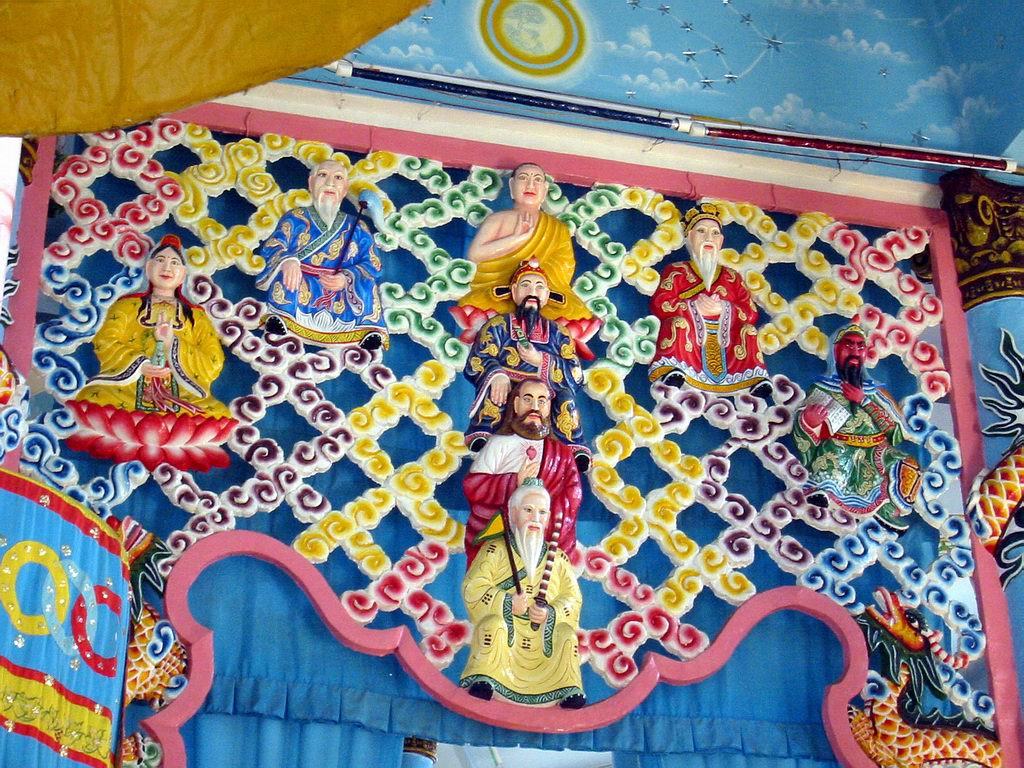


Core beliefs and influences
Cao Đài draws on ethical, cosmological, and ritual elements from several established traditions. It incorporates Buddhist ideas of karma and rebirth, Daoist ideas of spiritual practice, Confucian moral precepts and social ethics, and aspects of Christian organizational forms and imagery. Many adherents view its doctrine as synthesizing or revealing a universal truth, and spiritual communication—through mediums and séances—played a formative role in its early development. The religion therefore mixes scriptural-style messages with ethical guidance and devotional practice.
Key elements and practices
- Daily worship: Congregational prayer is an important routine, often performed at set times of the day in temple halls.
- Ritual dress and roles: Lay followers commonly wear white robes for services; clergy wear colored garments that indicate rank and liturgical function.
- Spiritism and revelations: Early founders and followers reported receiving messages from spiritual entities, which were incorporated into doctrine and ritual.
- Moral emphasis: Personal cultivation, charity, and ethical conduct draw heavily on Confucian and Buddhist influence.
Organization and sacred spaces
The movement developed a hierarchical organization with a centrally significant Holy See in Tây Ninh, where the largest and most elaborate temple complex stands. Its administrative vocabulary and offices draw inspiration from Christian ecclesiastical structures—using titles and ranks—but are adapted to local realities. Temples combine architectural motifs and decorative elements from East Asian and Western styles, producing a highly colorful and symbol-rich visual language; the "Divine Eye" is among the best-known emblems associated with Cao Đài.
History and social context
Cao Đài arose during the French colonial era, a period of intense cultural contact and political change in Vietnam. Founders such as Ngô Văn Chiêu, Phạm Công Tắc, Cao Quỳnh Cư and Cao Hoài Sang are traditionally credited with receiving early revelations and organizing the community. Throughout the 20th century the religion grew into a network of temples and lay associations, and it experienced varying relations with colonial and later national authorities—at times flourishing, at times being regulated or suppressed. Today it remains most visible in southern Vietnam but also has expatriate communities abroad.
Distinctive features and contemporary significance
Cao Đài is notable for its programmatic attempt to reconcile religious traditions and for its public, theatrical ritual life. Its syncretic roster of honored figures includes historical and religious teachers from diverse cultural backgrounds rather than a single canon, reflecting its universalist impulse. Practitioners and observers often highlight the movement's emphasis on unity, moral reform, and spiritual communication. For those interested in comparative religion, Cao Đài offers a living example of how new religious forms can synthesize older systems into a distinct institutional and devotional identity.
For further context on terminology and comparative strands, see connections to Buddhism, Taoism, Confucianism and Christianity. General overviews and studies of modern religion may treat Cao Đài among other new religious movements that arose in the modern era, and national histories of Vietnam often note its role in 20th‑century social life.
When researching further, readers may consult academic surveys of Southeast Asian religions and specialized works on Vietnamese religious history for detailed accounts of ritual calendars, gender roles in worship, clergy ranks, and the art and architecture of Tây Ninh's Holy See. Many of these sources discuss how the movement balances local Vietnamese customs with transnational religious currents in the modern period.
Related articles
Author
AlegsaOnline.com Cao Đài (Caodaism) — a syncretic Vietnamese religion Leandro Alegsa
URL: https://en.alegsaonline.com/art/16683
Sources
- caodai.org : "CAODAI, its concepts: Reason for the founding of CaoĐài"
- caodai.org : caodai.org/