
C (programming language)
C is a general-purpose, procedural programming language developed in the early 1970s for system programming. It influenced many later languages and remains widely used for low-level and portable software.
Overview
The C programming language is a general-purpose, procedural language that provides facilities for structured programming and low-level memory access. It is often described as "close to the hardware" because its abstractions map efficiently onto typical computer architectures. As a programming language, C balances expressive power with a small core of keywords, relying on a standard library for much functionality.
Image gallery
5 Images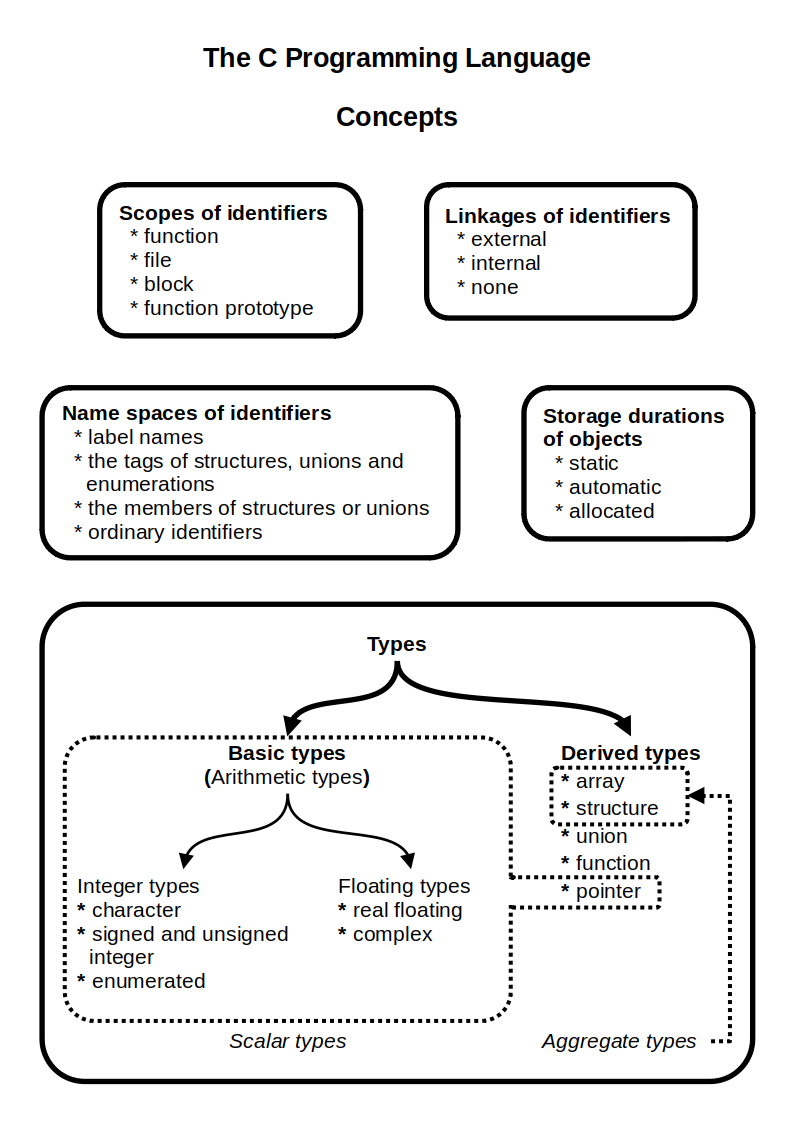



Characteristics
C is a compiled, imperative language that emphasizes explicit control of program flow and memory. Being a compiled language, C source is transformed by a compiler into machine-specific code, which can produce efficient executables that run directly on the computer. The language provides primitive types (integers, floating point, pointers), structured types (arrays, structs, unions) and functions, and leaves many runtime decisions to the programmer.
- Manual memory management: allocation and deallocation via library calls and pointer arithmetic.
- Low-level access: pointers and direct manipulation of bytes enable device drivers and system components.
- Small core: a concise set of operators and keywords with powerful composition via functions and headers.
History and development
C was created in the early 1970s at Bell Labs by Ken Thompson and Dennis Ritchie. It evolved from earlier languages used at the same lab and was originally developed to write parts of the operating system UNIX. The combination of portability and efficiency helped C spread beyond its original environment, and standardization efforts later produced formal specifications that guided compiler and library implementations.
Uses and examples
C is widely used where performance and close hardware control are important. Typical uses include operating system kernels, embedded firmware, runtime libraries, compilers, and performance-critical applications. Well-known systems written in or with substantial C components include Linux and parts of MacOS, among many others. Small console programs, utilities, and portable libraries also demonstrate how C serves both low-level and cross-platform needs.
Notable features and distinctions
Unlike many higher-level languages, C exposes concepts such as memory layout and calling conventions, enabling programmers to write code that maps closely to machine code. The language’s standard library (for example, programs commonly use headers for input/output and string handling) offers a modest set of building blocks rather than a large runtime. This design has influenced numerous successor languages and continues to make C a common choice where predictable performance and small runtime overhead are required.
Because C trades automatic safety features for control and efficiency, programmers must take care with types, buffer boundaries and resource management. When used carefully, C remains a foundational tool in software development and systems engineering.
Related articles
Author
AlegsaOnline.com C (programming language) Leandro Alegsa
URL: https://en.alegsaonline.com/art/15768