
British Rail Classes 485 and 486 (4Vec and 3Tis)
Ex-London Underground 'Standard' tube trains rebuilt in 1967 for Isle of Wight services as Classes 485 (4Vec) and 486 (3Tis); examples of re‑use of older tube stock on a mainline branch.
The British Rail Classes 485 and 486 were electric multiple units formed from pre‑war London tube rolling stock and adapted in the late 1960s for use on the Isle of Wight. Originally built for the London Electric Railway between 1923 and 1931 as 'Standard' tube stock, these cars were purchased by British Rail in 1967 and modified to operate on the newly electrified Ryde–Shanklin route. On the island they were known by departmental formations and nicknames: Class 485 usually appeared as four‑car sets called 4Vec, and Class 486 as three‑car sets called 3Tis.
Image gallery
2 Images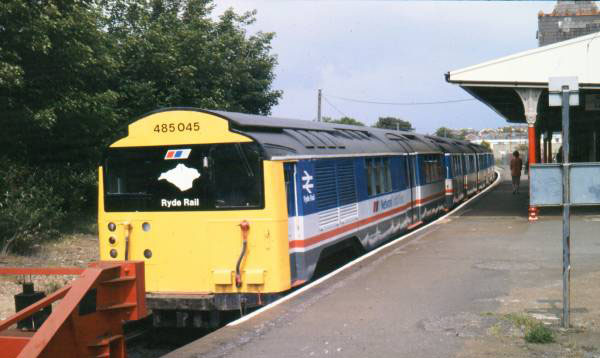

Design and technical characteristics
As former underground tube stock, the vehicles had a smaller loading gauge and narrower body profile than mainline Southern Region trains. That compact form made them a suitable, if unconventional, solution for the Island Line, whose tunnels and tight clearances limited the choice of available rolling stock. Key characteristics included:
- Third‑rail DC electric pick‑up compatible with Southern Region electrification
- Tube‑profile bodyshells with longitudinal seating typical of London suburban stock
- Reformed formations: 4‑car (4Vec) and 3‑car (3Tis) sets adapted for island service
- Modifications carried out to meet mainline operating requirements, including alterations to coupling, braking and interiors
Conversion and service on the Isle of Wight
When the Ryde–Shanklin line was electrified, these ex‑underground vehicles were chosen as an economical reuse of durable equipment that could fit the route’s restrictive clearances. Their introduction permitted the withdrawal of the last steam locomotives on the line and offered more regular, electrically powered services for local passengers. The units typically worked short, frequent shuttle services and remained largely confined to the Island Line because their dimensions and technical details limited interoperability with the wider network.
Later years and replacement
The Classes 485 and 486 served the Isle of Wight for two decades. By the late 1980s they were replaced by a different batch of former London Underground trains refurbished for island use. The replacement programme reflected the difficulty and cost of maintaining very old rolling stock as regulatory standards and passenger expectations changed. After withdrawal, most vehicles were dismantled or scrapped, though individual cars were sometimes saved by heritage groups.
Legacy and significance
These classes are often cited as practical examples of reusing older urban rolling stock in a challenging secondary environment. Their story illustrates how railway operators adapted available resources to local constraints rather than building new specialized stock. The conversion and island operation also highlight the technical compromises necessary when placing tube‑profile vehicles on a mainline branch, and they remain a point of interest for enthusiasts of British electric multiple units and Isle of Wight railway history.
For further context on the original vehicles and their London history see London Underground, and for information on the route and island context see Isle of Wight.
Related articles
Author
AlegsaOnline.com British Rail Classes 485 and 486 (4Vec and 3Tis) Leandro Alegsa
URL: https://en.alegsaonline.com/art/14538