
British Rail Class 506
A 1950s three-car electric multiple unit used on Manchester–Glossop–Hadfield services; notable for 1500 V DC operation, air-operated sliding doors and an unusual cab-end pantograph mounting.
Overview
The British Rail Class 506 was a small fleet of three-car electric multiple units built for suburban services on the Manchester to Glossop and Hadfield route on the Woodhead Line. Introduced in 1954, eight complete sets were allocated to this local network. The trains were purpose-designed for the line's overhead-electric system and local stopping services, and are commonly described simply as an electric multiple unit type.
Image gallery
5 Images


Design and technical features
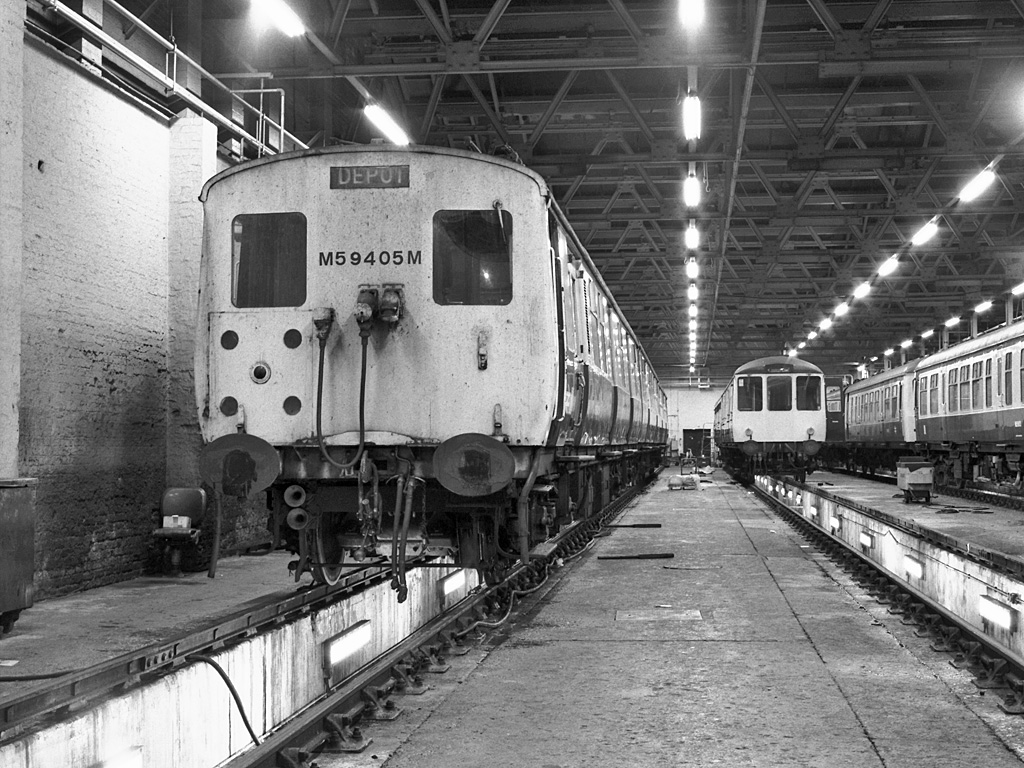
Class 506 units were compact three-car formations equipped for 1500 V DC overhead electrification. They featured air-operated sliding doors for passenger access, a convenience that reflected postwar design priorities for suburban rolling stock. One distinctive technical detail was the single diamond-shaped pantograph used to collect current from the overhead wire: unlike most British EMUs of the period, the pantograph was mounted over a driving cab and adjacent guard's compartment at the outer end of one driving vehicle rather than over a central trailer.
Service history and operations
The sets spent their working lives on local services radiating from Manchester to Glossop and Hadfield, providing short-distance commuter journeys with frequent stops. Their equipment and performance were tailored to the route's specific electrical arrangement and timetable demands. Over time, changes to regional electrification standards and service patterns affected the long-term viability of this small class.
Legacy and withdrawal
By the late 20th century, broader reorganisations of the railway network and shifts toward 25 kV AC overhead electrification made the niche 1500 V DC Class 506 sets increasingly obsolete. The units were gradually withdrawn as services were modernised or reorganised. The Class 506 remains of interest to railway historians and preservationists because it illustrates a transitional era of British electrification and suburban train design.
Notable characteristics and distinctions
- Three-car suburban formation built specifically for the Woodhead Line services.
- Equipment optimized for 1500 V DC overhead electrical supply.
- Air-operated sliding doors for passenger flow and station dwell-time reduction.
- Unusual pantograph placement — a single diamond pantograph located over a driving cab area — distinguishing it from many contemporary EMUs; see pantograph arrangements for comparison.
Today the Class 506 is remembered as a specialised and compact example of mid-20th-century British suburban electric traction. Its design choices reflect both the operational needs of a specific route and the diversity of electrification practices in the postwar period, making it a useful case study in the history of British railway electrification.
Related articles
Author
AlegsaOnline.com British Rail Class 506 Leandro Alegsa
URL: https://en.alegsaonline.com/art/14481