
Agra division (Uttar Pradesh, India)
Administrative division in western Uttar Pradesh centered on Agra; noted for Mughal monuments, Mathura pilgrimage sites, glass and leather industries, and mixed agricultural economy.
Agra division is an administrative unit in the Indian state of Uttar Pradesh, located in the north-central part of India. It is centered on the historic city of Agra and groups several neighbouring districts for purposes of governance and development. The division combines important cultural landmarks, pilgrimage centres and a largely agricultural hinterland.
Image gallery
1 Image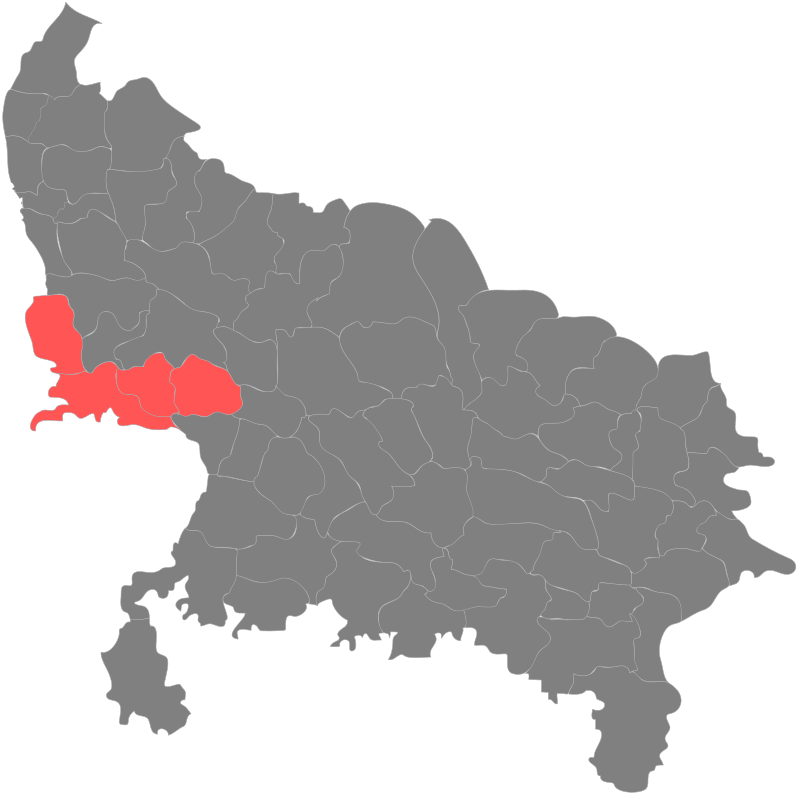
Components and geography
Administratively the division commonly comprises the districts of Agra, Firozabad, Etah, Mainpuri and Mathura. The area lies on the Indo‑Gangetic plain and is traversed by the Yamuna River and its tributaries. Soils are generally fertile, supporting cereals, oilseeds and sugarcane; the flat terrain has encouraged road and rail links between Agra and other major cities.
History and cultural significance
Agra grew into prominence during the Mughal era when it served as a political and artistic centre; many of the surviving monuments in the division date from that period. Mathura and the neighbouring town of Vrindavan are ancient centres of Hindu religious activity and attract pilgrims year‑round as the traditional birthplace and childhood landscape of the god Krishna.
Economy and industries
Economic life in the division is mixed. Tourism centred on Mughal architecture, notably the Taj Mahal in Agra, is a major source of income for the city. Firozabad is widely known for its glass and bangle industry, while Agra hosts leather and handicraft workshops. Beyond urban zones, agriculture and related processing—sugar mills, oilseed pressing and agro‑trade—remain important employment sources.
Administration and role
As with other state divisions, Agra division is an intermediate tier of administration grouping districts under a Divisional Commissioner. The division coordinates disaster relief, law and order, and implementation of state programmes across its districts while district magistrates handle local administration.
Notable facts and challenges
- Agra contains several UNESCO‑recognized monuments that draw international tourism.
- Mathura and Vrindavan are major pilgrimage destinations with extensive temple networks and festivals.
- Industrial clusters such as Firozabad's glassworks are regionally important but face environmental and labor challenges.
- River health, particularly of the Yamuna, and urban infrastructure pressures are ongoing regional concerns.
Together, these features make Agra division a region of considerable historical, cultural and economic diversity within Uttar Pradesh, balancing global tourism flows with local agriculture and manufacturing activity.
Related articles
Author
AlegsaOnline.com Agra division (Uttar Pradesh, India) Leandro Alegsa
URL: https://en.alegsaonline.com/art/1432