
Bristol County, Rhode Island
A small coastal county in eastern Rhode Island, created in 1747 from Massachusetts territory. Contains Bristol, Barrington and Warren; known for maritime history, waterfront towns and long Fourth of July traditions.
Bristol County is a coastal county in the U.S. state of Rhode Island. It is one of the state's five counties and, by population, the smallest: the 2010 census recorded 49,875 residents. The county seat is the town of Bristol, Rhode Island, a historic waterfront community that serves as the administrative and cultural center.
Image gallery
2 Images
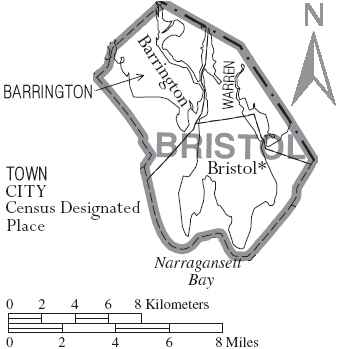
Geography and communities
Bristol County occupies a peninsula and adjacent shoreline on Narragansett Bay and Mount Hope Bay. Its coastline, small harbors and river inlets shaped local settlement and economy. The county is compact and primarily suburban and small-town in character, with a mix of residential neighborhoods, marinas, parks and preserved historic districts.
- Barrington — largely residential with shore access and neighborhood centers
- Bristol — the county seat, with museums, a waterfront port and historic Main Street
- Warren — an older mill and maritime town with a working harbor
History
The county was formed in 1747 when territory was transferred from Bristol County, Massachusetts to Rhode Island during colonial boundary adjustments. Its towns grew in the 18th and 19th centuries around shipbuilding, trade and small-scale industry. Bristol, in particular, developed as a port and civic center; the town is also noted for maintaining one of the nation's long-standing Fourth of July traditions, a civic celebration that contributes to its cultural identity.
Government and administration
Like other Rhode Island counties, Bristol County has limited county-level government functions. Most public services and local governance are provided by the three member towns and by state agencies. County boundaries are therefore most commonly used for judicial, statistical and administrative purposes rather than as a layer of local government with broad powers.
Economy, culture and recreation
The county economy is diverse on a small scale: residential and commuter patterns tie many residents to jobs elsewhere in the Providence metropolitan region, while local employment draws on tourism, small retail, maritime services and professional businesses. The shoreline and historic districts attract visitors for boating, festivals and cultural institutions, and local preservation efforts emphasize colonial and 19th-century architecture.
Notable facts and distinctions
Bristol County's modest population makes it the least populous county in the state. Its compact geography and concentration of historic waterfront towns give it a distinct identity within Rhode Island. For basic statistics and maps consult official state and census sources or local town websites for Barrington, Bristol and Warren; for a general locator map see county map.
For further reading and up-to-date demographic figures, refer to the most recent census releases and state publications. Many civic and cultural events, including Independence Day commemorations, are organized at the town level and are central to the county's public life.
Related articles
Author
AlegsaOnline.com Bristol County, Rhode Island Leandro Alegsa
URL: https://en.alegsaonline.com/art/14203
Sources
- quickfacts.census.gov : "State & County QuickFacts"
- publications.newberry.org : "Rhode Island: Individual County Chronologies"