
Joaquín “El Chapo” Guzmán: Mexican drug trafficker and former Sinaloa Cartel leader
Overview of Joaquín Archivaldo Guzmán Loera, known as El Chapo: his rise as leader of the Sinaloa Cartel, methods, arrests and escapes, extradition and conviction, and his impact on organized crime.
Overview
Joaquín Archivaldo Guzmán Loera (born 4 April 1957) is a Mexican former drug trafficker who led the Sinaloa Cartel, a criminal organization named for the Pacific coast state of Sinaloa. Commonly known by the nickname El Chapo ("Shorty"), Guzmán became an internationally recognized figure in narcotics trafficking and was described by the United States Department of the Treasury as among the most powerful traffickers in the world.
Image gallery
8 Images




Background and rise
Guzmán grew up in a rural region of Sinaloa and rose through Mexico's drug trade during the late 20th century. Over several decades he forged alliances, developed cross-border smuggling routes and expanded a network that distributed large quantities of illicit drugs to markets in North America and beyond. By the early 2000s he was widely viewed as the dominant leader of the Sinaloa Cartel after the capture or weakening of competing figures.
Methods and organization
The Sinaloa Cartel under Guzmán used a combination of clandestine transport, corruption, and financial networks to move drugs and launder proceeds. Investigations and reporting have documented a variety of techniques attributed to his organization, including sophisticated tunnel systems linking safe houses and prisons, maritime shipments and covert land routes. Guzmán's personal notoriety was amplified by his escapes from custody and by the cartel's resilient, decentralized structure.
Arrests, escapes and prosecution
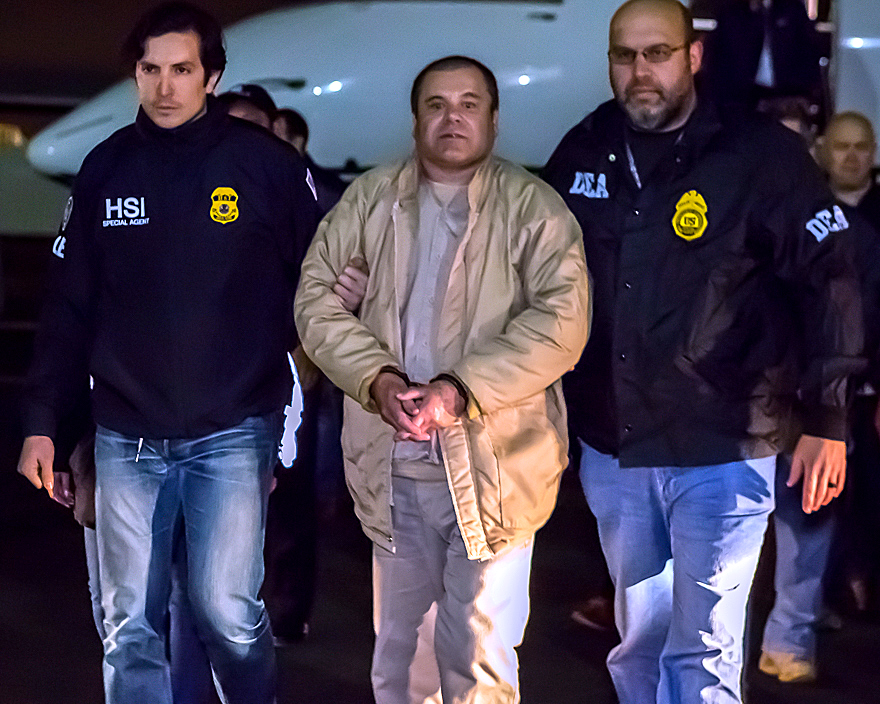
Guzmán was arrested and imprisoned on multiple occasions and also escaped, most famously in 2001 and again in 2015 by means widely reported in international media. Mexican authorities recaptured him on 22 February 2014, and again on 8 January 2016 in Los Mochis (Los Mochis), Sinaloa. He was extradited to the United States on 19 January 2017 to face federal charges, and a U.S. jury in Brooklyn found him guilty on multiple counts related to drug trafficking and organized crime in February 2019. He received a sentence of imprisonment to be served under U.S. custody.
Impact and legacy
Guzmán's career had wide-ranging effects on Mexico and international law enforcement. His leadership contributed to the cartel's expansion and to sustained violence and instability in regions contested by rival groups. The pursuit, capture and trial of Guzmán highlighted cross-border cooperation in policing and prompted debate about anti-narcotics strategy, organized crime governance and the social costs of illicit markets. His life and criminal career have also entered popular culture and public discourse about transnational organized crime.
Notable facts and distinctions
- Nickname: "El Chapo" reflects Guzmán's short stature and is a widely used media sobriquet.
- Designation: He was subject to international sanctions and criminal charges, including those recorded by the United States Department of the Treasury.
- Legal status: After extradition to the United States in 2017, Guzmán was convicted in 2019 and remains in U.S. custody.
For further context on organized crime and law enforcement responses, see related resources on narcotics trafficking and cartel dynamics (Sinaloa Cartel). Additional background on locations and institutions mentioned here can be found through regional or governmental sources.
Questions and answers
Q: Who is Joaquín Archivaldo Guzmán Loera?
A: Joaquín Archivaldo Guzmán Loera is a Mexican drug lord who headed the Sinaloa Cartel, a criminal organization.
Q: What nickname does he have?
A: He is known as "El Chapo Guzmán" ("Shorty Guzmán") due to his 1.68 m (5 ft 6 in) height.
Q: When did he become Mexico's top drug kingpin?
A: He became Mexico's top drug kingpin in 2003 after the arrest of his rival Osiel Cárdenas of the Gulf Cartel.
Q: How was he described by the United States Department of the Treasury?
A: The United States Department of the Treasury described him as one of "the most powerful drug traffickers in the world".
Q: When and where was he arrested for a second time?
A: He was arrested for a second time on February 22, 2014 in Mazatlan, Mexico.
Q: Where was he captured at following a gun battle by the Mexican Navy? A: He was captured at Los Mochis, northern Sinaloa on January 8, 2016 following a gun battle by the Mexican Navy.
Q: When was he extradited to face criminal charges related to his leadership of the Sinaloa Cartel? A: He was extradited to face criminal charges related to his leadership of the Sinaloa Cartel on 19 January 2017.
Q: When and what verdict did he receive from a jury in Brooklyn ? A: On 12 February 2019 ,he received guilty verdicts from a jury in Brooklyn on all drug trafficking counts and is scheduled for life imprisonment .
Author
AlegsaOnline.com Joaquín “El Chapo” Guzmán: Mexican drug trafficker and former Sinaloa Cartel leader Leandro Alegsa
URL: https://en.alegsaonline.com/art/140440