
Carbonic acid (H2CO3): properties, reactions, and environmental role
Carbonic acid (H2CO3) is a weak, short-lived acid formed when carbon dioxide dissolves in water. It controls bicarbonate/carbonate chemistry, buffers blood and oceans, and weathers carbonate rocks.
Overview: Carbonic acid is the hydrated form of carbon dioxide with the chemical formula H2CO3. It is better described as a component of the dissolved CO2–water system than as a stable standalone substance. In aqueous solution it exists in equilibrium with dissolved CO2 and partly dissociates to release protons, so it behaves as a weak acid.
Image gallery
1 Image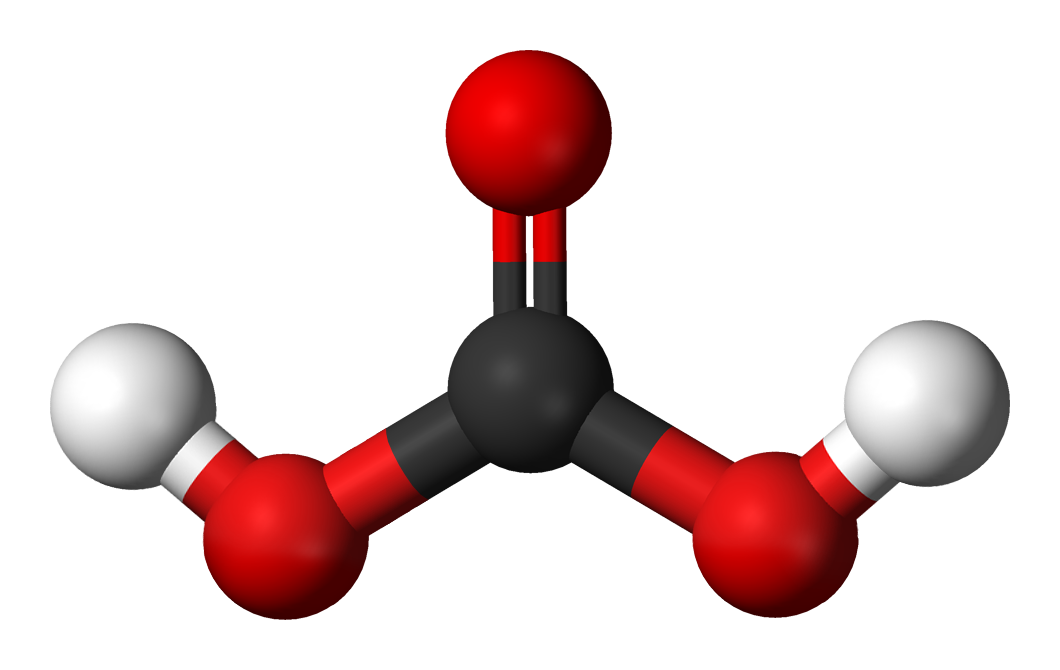
Properties and equilibrium
Carbonic acid is unstable in isolation and rapidly interconverts with CO2 and H2O. The acid dissociation occurs in two steps, producing bicarbonate (HCO3−) and carbonate (CO3 2−) ions; the pKa values that describe these steps are approximately in the mid single digits and around ten for the second dissociation. Enzymes such as carbonic anhydrase accelerate the CO2/H2O ⇌ H2CO3 interconversion in biological systems.
Salts and reactions
Its conjugate bases form two main classes of salts: bicarbonates and carbonates. Typical examples include sodium bicarbonate and calcium carbonate. Bicarbonates are important soluble carriers of inorganic carbon in natural waters, while carbonates form insoluble solids that build shells and sedimentary rocks. Industrial and laboratory reactions often exploit these equilibria for pH control and CO2 capture.
Formation and uses
Carbonic acid forms when atmospheric or pressurized CO2 dissolves in water; this is the basis of carbonated beverages and the transient acidity they display. In physiology the bicarbonate–carbonic acid system is a primary buffer in blood, helping maintain pH. Carbonic acid itself has few direct industrial applications because it readily decomposes to carbon dioxide and water.
Geological and environmental significance
In geology, carbonic acid reacts with carbonate minerals like limestone (calcium carbonate), promoting dissolution that produces soluble calcium bicarbonate and contributes to karst landscapes, cave formation, and the transport of dissolved inorganic carbon. This same chemistry underlies concerns about ocean acidification, where increased dissolved CO2 shifts equilibria and reduces carbonate ion availability for marine organisms.
Notable distinctions: In many contexts the term "carbonic acid" is used loosely to denote the suite of dissolved inorganic carbon species (CO2(aq), H2CO3, HCO3−, CO3 2−). Pure, isolable H2CO3 is rare; most practical descriptions focus on the equilibrium behavior that governs acidity, buffering, and mineral interactions.
Author
AlegsaOnline.com Carbonic acid (H2CO3): properties, reactions, and environmental role Leandro Alegsa
URL: https://en.alegsaonline.com/art/136099
Sources
- anaesthesiamcq.com : "2.1 Acid-Base Balance"