
Mimar Sinan: Ottoman Chief Architect and Master of Imperial Mosque Design
Mimar Sinan (1489–1588) was the Ottoman Empire's chief architect for about fifty years, responsible for hundreds of buildings including the Selimiye Mosque and the Süleymaniye Mosque and major innovations in dome construction.
Overview
Mimar Sinan (c. 1489–1588) was the leading architect and civil engineer of the Ottoman Empire in the 16th century. Serving under sultans Suleiman the Magnificent, Selim II and Murad III, he held a senior official position for roughly five decades and is credited with designing and supervising the construction of a large number of mosques, bridges, aqueducts, hospitals, madrasas and palaces. His Turkish name and legacy are discussed widely in modern sources; see Mimar Sinan for his cultural identity and reputation.
Image gallery
10 Images


Architectural approach and characteristics
Sinan refined the Ottoman mosque plan by combining a dominant central dome with supporting semi-domes, buttressing systems and light management to create spacious, unified interiors. He paid careful attention to proportions, circulation, acoustics and visual axes, producing buildings that balanced structural daring with restrained ornament. His projects often formed complex charitable and civic ensembles (külliye) that included social services as well as the primary religious structure.
Major works
Although opinions differ on the exact tally, Sinan is associated with hundreds of projects of varying scale. The most celebrated among them include:
- Süleymaniye Mosque in Istanbul — often described as his most famous urban masterpiece.
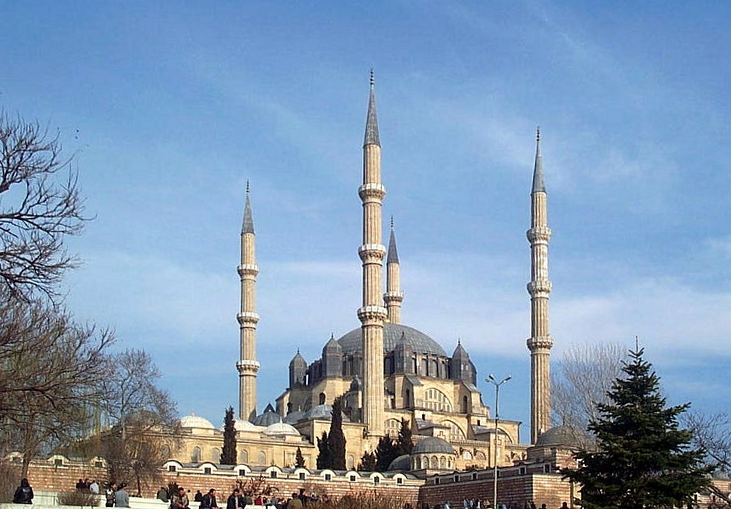
- Selimiye Mosque in Edirne — widely regarded by historians as his architectural pinnacle because of its daring central dome and purity of form.
- Numerous smaller mosques, caravanserais, bridges, aqueducts and public buildings across Anatolia and the Balkans.
History and development
Sinan's career began in the early 16th century after military service and technical training. Over decades he adapted lessons from Byzantine and earlier Islamic architecture while advancing new engineering solutions for large domes and slender support systems. His role combined design, supervision, and administration of imperial building projects, enabling consistent aesthetic and technical standards across the empire.
Legacy and notable facts
Sinan influenced Ottoman architecture for generations and remains a central figure in studies of Islamic and world architecture. He is often compared to architects who defined national building traditions, and his mosques continue to attract scholarly attention and visitors. His life and work are documented in Ottoman chronicles and later biographies, and his achievements are integral to the architectural heritage of Istanbul, Edirne and many other cities.
For contextual reading, see general entries on the Ottoman architectural tradition and the role of the imperial architect (Ottoman) and consider site-specific resources on the two signature mosques cited above.
Author
AlegsaOnline.com Mimar Sinan: Ottoman Chief Architect and Master of Imperial Mosque Design Leandro Alegsa
URL: https://en.alegsaonline.com/art/127081