
List of rivers of India
Organized guide to rivers in India: how river lists are arranged by coast and tributary order, major basins and examples, plus cultural, economic and geographic notes.
Overview
India's river network is diverse, ranging from the snow-fed Himalayan streams to the peninsular rivers that drain into the Bay of Bengal and the Arabian Sea. A comprehensive "list of rivers" typically groups waterways by their outlet basin and by the relationships between main rivers and their tributaries. Such lists help researchers, planners and the public understand hydrology, navigation and water management in the subcontinent.
Image gallery
5 Images


How lists are organized
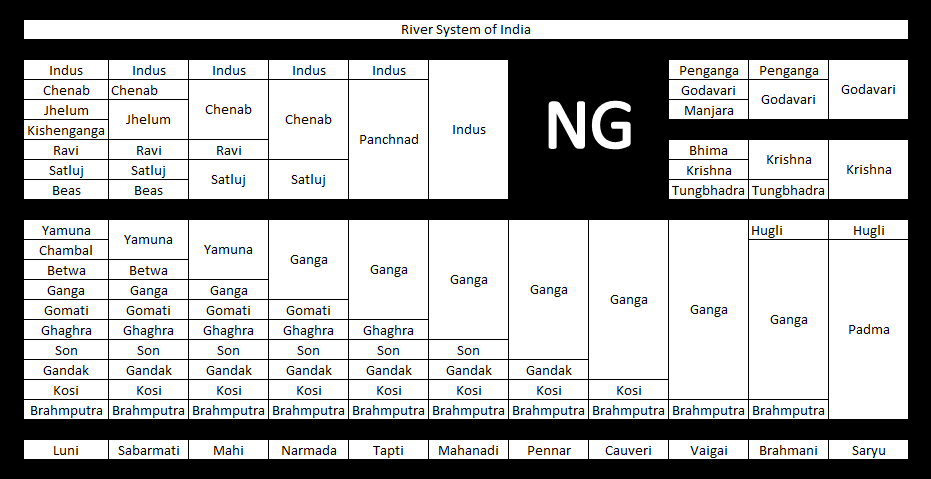
Common presentation follows two complementary rules. First, rivers that empty into the sea are arranged geographically along the coastline—starting from the eastern side (Bay of Bengal) and moving south to the southern tip at Kanyakumari, then continuing north along the western coast toward the Arabian Sea. For an example of this coastal ordering see Bay of Bengal ordering and Kanyakumari reference. Second, tributaries are shown in upstream order: within a given basin, smaller rivers are listed such that the lower (downstream) tributaries appear later than more upstream ones; many formal lists explain this convention (see tributary ordering).
Major river systems and examples
River lists commonly highlight several major systems: the Ganges–Brahmaputra basin in the north, the Indus system in the northwest, and the peninsular rivers such as the Godavari, Krishna, Cauvery (Kaveri), Mahanadi, Narmada and Tapi. These basins include numerous well-known tributaries—examples include the Yamuna and Ghaghara within the Ganges system, and the Beas and Sutlej in the Indus system. Coastal and island rivers are also catalogued in dedicated sections. For a general compiled list consult the national or regional registers linked from the main index here.
Uses, significance and management
Lists of rivers serve multiple purposes: hydrological research, planning of irrigation and hydroelectric projects, flood forecasting and environmental conservation. Rivers are central to agriculture, transport (where navigable), and cultural life; many towns and cities grew along major waterways. Modern river lists are often used alongside maps and basin reports for water allocation and ecosystem protection.
Historical and cultural notes
Rivers in India carry deep historical and cultural associations, featuring in religious traditions, literature and regional identities. Historical trade routes and ancient settlements frequently followed river valleys. Over time, human modifications—dams, canals and diversions—have altered natural courses, so current lists may distinguish between natural tributaries and engineered channels.
Reading and using a river list
When consulting a list, note the sorting rules (coastal progression and upstream tributary order), the scope (national, state or basin-level), and whether ephemeral streams are included. Many compilations provide cross-references to maps and basin studies; see coastal sequencing toward the Arabian Sea and further technical notes at the linked resources above. Accurate interpretation requires attention to local naming variants and administrative boundaries.
Questions and answers
Q: What is the purpose of the text?
A: The purpose of the text is to provide readers with a list of rivers in India, both those that flow into the sea and tributary rivers, sorted geographically.
Q: How are the rivers that flow into the sea sorted?
A: The rivers that flow into the sea are sorted geographically, along the coast starting from the Bay of Bengal in the east and moving southward to Kanyakumari, then northward along the Arabian Sea.
Q: How are the tributary rivers listed?
A: The tributary rivers are listed in upstream order, with the lower rivers in the list being further upstream than those higher up the list.
Q: What is the significance of the order of the tributary rivers?
A: The order of the tributary rivers is significant as it reflects their relative position in the river system and their proximity to the main river.
Q: Is every river in India included in the list?
A: It is not clear from the text whether every river in India is included in the list.
Q: What is the significance of sorting rivers geographically?
A: Sorting rivers geographically makes it easier to locate and understand their position in relation to other rivers and bodies of water.
Q: Is there any additional information provided about the rivers in India?
A: No, there is no additional information provided about the rivers in India beyond their names and their position in the list.
Related articles
Author
AlegsaOnline.com List of rivers of India Leandro Alegsa
URL: https://en.alegsaonline.com/art/125018
Sources
- envis.maharashtra.gov.in : "Classification of Waters of Wainganga Indravati Wardha Penganga River Basin"