
Counties of Maryland: list, overview and key facts
An organized overview of Maryland's counties, the independent city of Baltimore, their roles, history, and a full alphabetical list of the state's counties.
Overview
Maryland is divided into counties that serve as primary local government units. In addition to the counties, Baltimore City is an independent city and is treated as a county-equivalent for many administrative and statistical purposes. Modern county government in Maryland handles many local services and land-use matters, although the state retains authority over some functions.
Image gallery
10 Images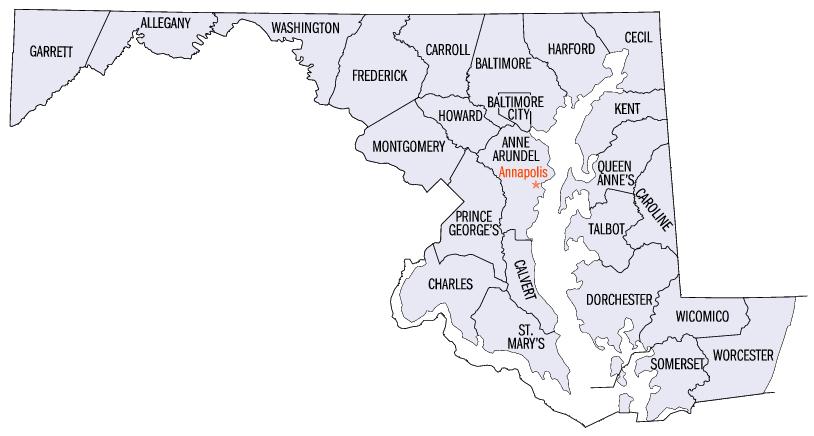


Counties (alphabetical list)
The state contains 23 counties. The complete alphabetical list below is a basic reference; Baltimore City is separate and is not part of any county.
- Allegany
- Anne Arundel
- Baltimore County
- Calvert
- Caroline
- Carroll
- Cecil
- Charles
- Dorchester
- Frederick
- Garrett
- Harford
- Howard
- Kent
- Montgomery
- Prince George's
- Queen Anne's
- St. Mary's
- Somerset
- Talbot
- Washington
- Wicomico
- Worcester
Government, functions and variations
County governments commonly provide public education administration, local road maintenance, zoning and building permits, public health services, and law enforcement. Some counties operate under locally adopted charters that grant broader "home rule," while others are governed under state statutes. The balance of responsibilities varies by county.
History and notable distinctions
Maryland's county structure dates back to the colonial era and evolved as the population and economy changed. Baltimore City, once part of Baltimore County, separated to become an independent city; it functions like a county for many legal and statistical purposes. For official listings and further administrative details see the county list and resources from the state government.
Why this matters
Knowing the counties is useful for understanding local governance, property records, school districts, judicial districts, and regional planning. Whether researching genealogy, real estate, or civic procedures, identifying the correct county helps locate records and services more efficiently.
Questions and answers
Q: How many counties are there in Maryland?
A: There are twenty-four counties and one independent city called Baltimore City in Maryland.
Q: Is Baltimore City considered a county in Maryland?
A: No, it is not considered a county. However, it is a county-equivalent for most purposes.
Q: How many county-equivalents are there in Maryland?
A: There is only one county-equivalent in Maryland, which is Baltimore City.
Q: Are all the counties in Maryland identical in size and population?
A: No, the counties in Maryland differ in size and population.
Q: What is the significance of Baltimore City being a county-equivalent?
A: Being a county-equivalent means that Baltimore City has similar rights, powers, and functions as a county in Maryland.
Q: Can Baltimore City be counted as a separate entity from the counties in Maryland?
A: Yes, despite being a county-equivalent, Baltimore City is considered a separate entity from the other counties in Maryland.
Q: What is the purpose of having counties in Maryland?
A: Counties are used for administrative and political purposes, such as organizing local government and providing public services to residents.
Related articles
Author
AlegsaOnline.com Counties of Maryland: list, overview and key facts Leandro Alegsa
URL: https://en.alegsaonline.com/art/124612
Sources
- epa.gov : "EPA County FIPS Code Listing"
- msa.md.gov : "Counties"
- naco.org : "NACo - Find a county"
- factfinder.census.gov : "American FactFinder"
- quickfacts.census.gov : "Maryland QuickFacts"