
Counties of New Hampshire
An overview of New Hampshire's ten counties: names, origins, government roles, and identifiers (including FIPS state code 33). Lists counties and notes historical and administrative context.
Overview
New Hampshire is divided into ten counties, the primary political subdivisions used for judicial, electoral, and certain administrative purposes. Counties in New Hampshire provide a framework for courts, law enforcement, property records, and some social services, while many day-to-day responsibilities are handled by towns and cities. For official listings and specific county pages see the state's county resource: counties page, general state information: state site, or a broader introduction to New Hampshire: New Hampshire overview.
Image gallery
2 Images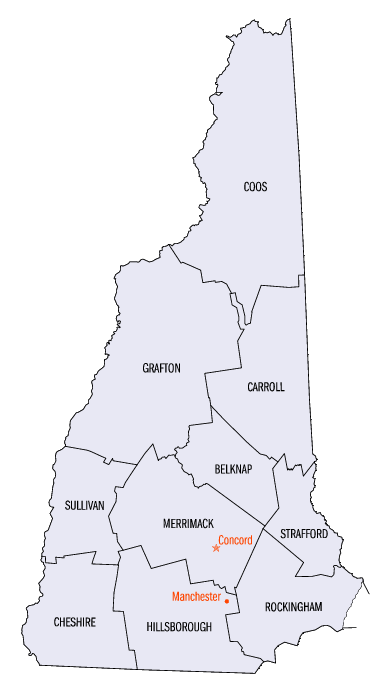

History and development
County boundaries and institutions in New Hampshire grew out of colonial-era administration. Five of the modern counties trace their origin to 1769, when New Hampshire was still a British colony; others were created later as settlement and governance needs evolved. Over time county functions and boundaries have been adjusted, but the ten-county structure has remained stable and continues to reflect regional communities and court circuits.
List of counties
The ten counties of New Hampshire are listed below. Brief regional notes follow each name to indicate general location within the state.
- Belknap — central Lakes Region
- Carroll — eastern, near the White Mountains
- Cheshire — southwestern, along the Vermont border
- Coös — northernmost, largest by land area
- Grafton — west-central, includes parts of the White Mountain foothills
- Hillsborough — southern, contains several of the state's largest cities
- Merrimack — central, runs through the state capital region
- Rockingham — southeastern, Atlantic coast and suburbs
- Strafford — southeastern interior
- Sullivan — west-central, along the Connecticut River
Government, duties, and distinctions
County government in New Hampshire is typically organized around elected county commissioners, a sheriff, and other officers responsible for county courts, jails, registries of deeds, and some social or health services. Unlike many parts of the United States, New England places considerable emphasis on town and municipal government; as a result, counties in New Hampshire often perform a narrower set of services than counties elsewhere.
Identifiers and practical uses
For statistical and administrative purposes each county is assigned a Federal Information Processing Standard (FIPS) code. The state code for New Hampshire is 33, and each county has a unique three-digit code appended to that state number to form a five-digit identifier. These FIPS codes are widely used in federal datasets, mapping, emergency planning, and research to uniquely identify county-level units.
Notable facts
Coös County, in the far north, is notable for its large area and low population density compared with southern counties. Southern counties, particularly those contiguous with Massachusetts and near the seacoast, concentrate a larger share of the state's residents and economic activity. While counties remain important legal and administrative units, everyday civic life in New Hampshire is deeply organized around towns and cities, a hallmark of New England governance.
Questions and answers
Q: How many counties are in the state of New Hampshire?
A: There are 10 counties in the state of New Hampshire.
Q: When were five of the counties formed?
A: Five of the counties were formed in 1769.
Q: In what time period was New Hampshire still an English colony?
A: New Hampshire was still an English colony when the five counties were formed in 1769.
Q: What is the Federal Information Processing Standard (FIPS) code, and how is it used?
A: The FIPS code is a five-digit code that uniquely identifies counties and county equivalents in the United States.
Q: What is the FIPS county code for New Hampshire?
A: The FIPS county code for New Hampshire is 33.
Q: What is the significance of the three-digit number in the FIPS county code?
A: The three-digit number is unique for each county within a state.
Q: Where can one find more information about a specific county's FIPS code?
A: One can find more information about a specific county's FIPS code on the Census Bureau Info page for that county, accessed through the links provided in the FIPS County Code column.
Related articles
Author
AlegsaOnline.com Counties of New Hampshire Leandro Alegsa
URL: https://en.alegsaonline.com/art/124621
Sources
- epa.gov : "EPA County FIPS Code Listing"
- naco.org : "NACo - Find a county"
- usroots.com : "New Hampshire Counties"
- quickfacts.census.gov : "New Hampshire QuickFacts"