
List of counties in Florida
An overview and complete alphabetical list of Florida’s 67 counties, with notes on their roles, development, and notable variations in government and population.
Florida is divided into 67 counties, each serving as a key unit of local government for administration, courts, property records, public services and land use. The counties vary widely in population, geography and urban character — from dense metropolitan areas in South Florida to large rural counties in the Panhandle and central regions. For an official directory and further details, see the state county listings.
Image gallery
3 Images
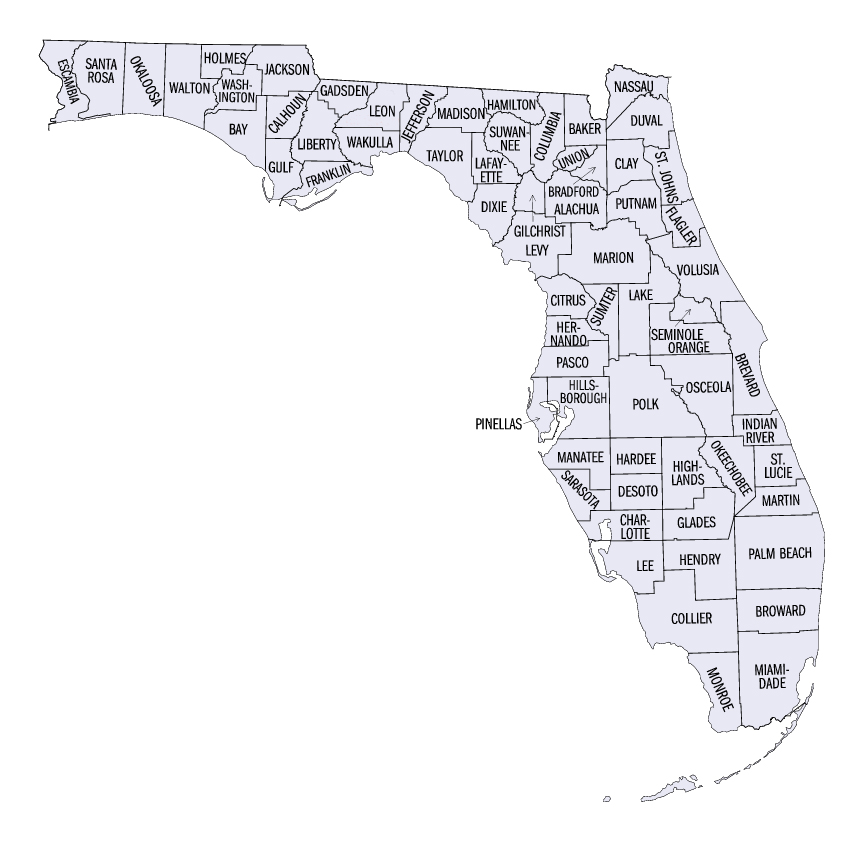

List of counties (alphabetical)
- Alachua
- Baker
- Bay
- Bradford
- Brevard
- Broward
- Calhoun
- Charlotte
- Citrus
- Clay
- Collier
- Columbia
- Miami-Dade
- DeSoto
- Dixie
- Duval
- Escambia
- Flagler
- Franklin
- Gadsden
- Gilchrist
- Glades
- Gulf
- Hamilton
- Hardee
- Hendry
- Hernando
- Highlands
- Hillsborough
- Holmes
- Indian River
- Jackson
- Jefferson
- Lafayette
- Lake
- Lee
- Leon
- Levy
- Liberty
- Madison
- Manatee
- Marion
- Martin
- Monroe
- Nassau
- Okaloosa
- Okeechobee
- Orange
- Osceola
- Palm Beach
- Pasco
- Pinellas
- Polk
- Putnam
- Santa Rosa
- Sarasota
- Seminole
- St. Johns
- St. Lucie
- Sumter
- Suwannee
- Taylor
- Union
- Volusia
- Wakulla
- Walton
- Washington
Each county has an established county seat where government offices and courts are usually located. Many county names reflect local history, prominent figures, Indigenous words, or geographic features. County boundaries and names were established over the nineteenth and twentieth centuries as Florida’s population expanded and new administrative needs emerged.
County governments in Florida typically operate under an elected board of county commissioners (or a similar governing body) and provide services such as law enforcement (sheriff’s offices), tax assessment and collection, public health, emergency management, road maintenance and land-use planning. Municipalities within counties provide local services in towns and cities; the balance of responsibilities varies by county and by charter.
There is variation in how counties are organized. Some counties have unique charter provisions or stronger central administrations for metropolitan regions. A widely noted example is the consolidated government of the City of Jacksonville and Duval County, which merged many city and county functions to reduce duplication and coordinate services across a larger urban area. Elsewhere, counties range from heavily suburban and urban to sparsely populated rural jurisdictions with different priorities for infrastructure and conservation.
For many uses — legal, genealogical, planning or statistical — knowing the county is essential because public records such as deeds, court files and vital records are normally maintained at the county level. The full list above provides a straightforward reference to all 67 counties that make up the state of Florida.
Related articles
Author
AlegsaOnline.com List of counties in Florida Leandro Alegsa
URL: https://en.alegsaonline.com/art/124604
Sources
- epa.gov : "United States Environmental Protection Agency (EPA) County FIPS Code Listing"
- naco.org : "NACo – Find a county"