
Karl Weierstrass: founder of modern rigor in analysis
German mathematician Karl Weierstrass (1815–1897), who established rigorous foundations for real and complex analysis, advanced function theory and approximation, and influenced generations through clear, formal methods.
Karl Theodor Wilhelm Weierstraß (31 October 1815 – 19 February 1897) was a German mathematician whose insistence on precise definitions and careful proofs helped transform analysis into a rigorous, arithmetical discipline. Working in the mid and late 19th century, he emphasized limits, power series and explicit constructions that removed several informal steps common in earlier accounts of calculus.
Image gallery
2 Images
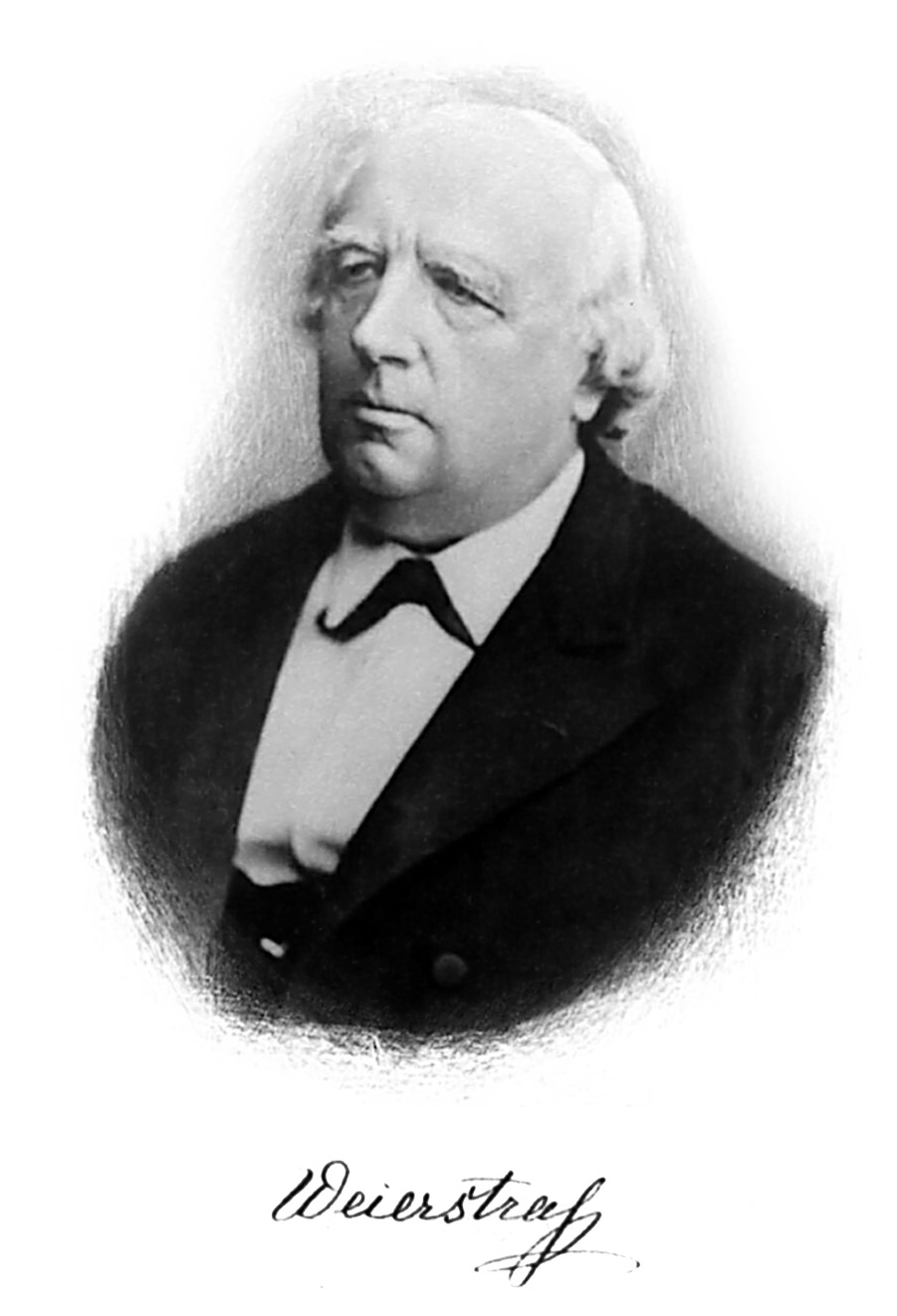
Life and career
Weierstraß grew up in the Kingdom of Prussia and trained first as a schoolteacher; he spent many years teaching before obtaining a university professorship. His path to academic recognition was unusual for the time: much of his early research was produced while he worked away from the major research universities. Later he held a prominent chair in Berlin and became widely respected for his lecture courses and for mentoring younger mathematicians, including notable women students who otherwise faced barriers to formal academic study.
Main contributions
Weierstraß is remembered for making analysis more rigorous and for concrete theorems and counterexamples that clarified the subject. Key areas include:
- Foundations of real analysis — development of epsilon–delta formulations of limits, continuity and uniform convergence and the promotion of arithmetic methods over geometric intuition.
- Approximation theory — the Weierstrass approximation theorem, which asserts that continuous functions on a closed interval can be uniformly approximated by polynomials, is a cornerstone of approximation and functional analysis.
- Counterexamples — explicit constructions, most famously a continuous nowhere-differentiable function, showed that continuity does not imply differentiability and encouraged more precise hypotheses in theorems.
- Complex and elliptic function theory — rigorous use of power series and product representations contributed to the arithmetization of complex analysis and to the theory of elliptic functions.
- Other areas — he influenced work in the calculus of variations and differential geometry by importing analytic precision into those fields.
Approach and legacy
Weierstraß criticized vague reasoning and sought arguments that could be formulated and checked arithmetically; this stance helped consolidate modern standards of proof and definition in mathematics. His lecture notes and published papers spread his methods: ideas about power series manipulation and uniform convergence remain standard tools, and several results still bear his name, such as the Bolzano–Weierstrass principle discussed in texts on compactness and sequences (Bolzano–Weierstrass).
Writings and edited lecture notes provide entry points to his methods; for biographical material see a general biography and summaries of his influence on logic and foundations at foundations. Overviews of modern analysis, the role of power series in function theory, the connections to differential geometry and surveys of the calculus of variations provide further context for his work and its lasting importance.
Related articles
Author
AlegsaOnline.com Karl Weierstrass: founder of modern rigor in analysis Leandro Alegsa
URL: https://en.alegsaonline.com/art/123340