
James Rosenquist: American Pop Artist and Pioneer of Large-Scale Montage
A concise account of James Rosenquist’s life, techniques, major works (including F-111), role in Pop Art, and lasting influence on contemporary art.
James Rosenquist (November 29, 1933 – March 31, 2017) was an American painter whose large-scale, image-saturated works became central to the Pop Art movement of the 1960s. He is best known for compositions that borrow from advertising, mass media and consumer culture, reworking familiar commercial fragments into sprawling, often disjunctive visual narratives. Rosenquist’s paintings bridged the techniques of commercial billboard production and the concerns of fine art, contributing to debates about image, scale and cultural meaning.
Image gallery
2 Images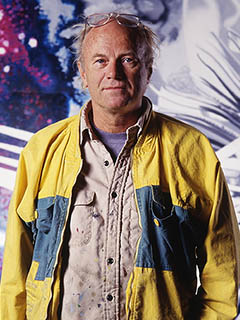

Artistic style and technique
Rosenquist began his career as a commercial billboard painter, and many of his signature methods reflect that training. He worked on a monumental scale, assembling multiple panels into a single canvas and using bright, enamel-like colors, precise edge work and abrupt spatial shifts. His compositions frequently juxtapose disparate objects — parts of faces, fragments of machines, consumer goods — which the artist arranged to create associative or dreamlike sequences rather than literal narratives. The visual language he developed emphasized repetition, cropped framing, exaggerated scale and the visual grammar of advertising.
Major works and recurring themes
- F-111 (mid-1960s): One of Rosenquist’s most discussed paintings, it merges imagery of a fighter-bomber with domestic and commercial objects to comment on technology, politics and consumer culture in the Cold War era.
- President Elect and early billboard-derived panels: These examples show his use of celebrity, political iconography and found media imagery to probe public perception and mass communication.
- Recurring themes: the intersection of commerce and everyday life, the ambivalent allure of mass-produced imagery, and the tension between surface spectacle and deeper social commentary.
Career, context and relationships
Emerging in the same period as other Pop artists, Rosenquist is often grouped with figures such as Andy Warhol and Roy Lichtenstein. He maintained that, while critics labeled them a movement, many of the artists arrived at similar concerns independently and via different routes. Rosenquist’s path from commercial production to gallery-scale painting helped define a strand of Pop Art that foregrounded pictorial montage and billboard aesthetics rather than the silk-screen techniques associated with some contemporaries.
Influence, exhibitions and recognition
Over a long career Rosenquist exhibited widely in museums and galleries internationally. He influenced later generations of artists who explored image appropriation, scale and the relationship between fine art and popular culture. In 2001 he was inducted into the Florida Artists Hall of Fame, a recognition of his contribution to American art. Critics and historians continue to cite his work when discussing how postwar art responded to the proliferation of mass media.
Legacy and notable facts
Rosenquist continued to work into his later decades, often returning to themes of memory, politics and consumer imagery. He died on March 31, 2017, at his home in New York City after a long illness. Today his paintings remain in major public and private collections and are frequently included in exhibitions that examine Pop Art and its aftermath. His career is notable for demonstrating how commercial techniques and imagery can be retooled to ask serious questions about modern life and culture.
Related articles
Author
AlegsaOnline.com James Rosenquist: American Pop Artist and Pioneer of Large-Scale Montage Leandro Alegsa
URL: https://en.alegsaonline.com/art/121366
Sources
- florida-arts.org : James Rosenquist
- myartspace.com : "Art Space Talk: James Rosenquist"
- nytimes.com : "James Rosenquist, Pop Art Pioneer, Dies at 83"