
Gopher (protocol) — an early menu-based Internet document system
Gopher is a lightweight, menu-driven network protocol from the early 1990s for distributing, searching and retrieving documents. It remains in niche use among enthusiasts and archival projects.
Overview
Gopher is a simple, text-oriented application protocol created to organize and retrieve documents on the Internet. It presents information as hierarchical menus: a user selects an item from a menu and the server either returns a file or another menu. Designed for low bandwidth and straightforward navigation, Gopher uses short, line-oriented requests over a dedicated port and a compact response format. For technical details and specifications see protocol documentation.
Image gallery
1 Image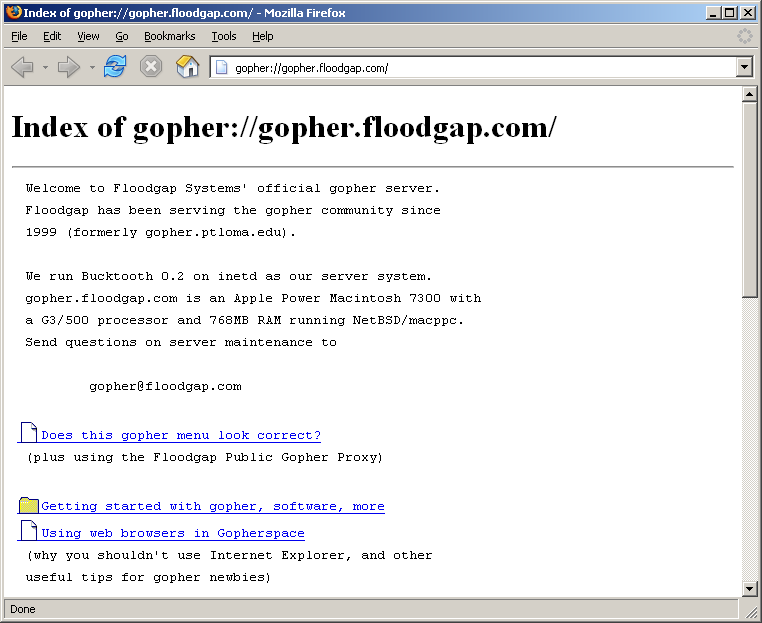
Key characteristics
Gopher is notable for its minimal design and predictable behavior. Rather than embedding markup within documents, it relies on a typed menu system where each entry carries a type code and a selector string. This makes clients simple to implement and menus easy to browse. Typical traits include:
- Menu-driven hierarchy rather than hypertext pages; navigation tends to resemble directory trees.
- Line-oriented request/response exchanges that are compact and quick to parse.
- Support for plain text, binary files, searches, and pointers to other servers or services.
- Extremely low client complexity compared with full-featured web browsers.
Because of its simple structure, Gopher is often contrasted with the World Wide Web and HTTP-based content, highlighting different design choices and goals; an accessible comparison can be found at comparative resources.
History and development
Gopher emerged in the early 1990s as one of several systems for distributing information across academic networks. It was developed to provide an organized, searchable menu system at a time when graphical browsers and HTML were only beginning to appear. Gopher gained rapid adoption on campuses but then lost momentum in the wider Internet community. A notable factor in its decline was concern about licensing and commercial restrictions that were discussed in public forums, which discouraged some organizations from adopting it. The Web’s flexibility and the explosive growth of HTML tools also contributed to the shift away from Gopher; for contemporary reflections see historical notes.
Implementations, clients and servers
Several server and client implementations remain available and maintained by hobbyists and archival projects. Examples include small, lightweight servers that expose Gopher content and gateways that translate Gopher menus into HTML so modern browsers can reach Gopher resources. For lists of software and server packages, see software directories and community-maintained indexes such as server lists. Some servers provide front-ends for mobile formats or scripting support; a few implementations bundle additional interfaces like WML for early mobile devices or PHP hooks for dynamic content generation.
- Python-based servers and simple daemons are popular among newcomers because they are easy to host and extend.
- Gateways and web proxies allow Gopher resources to be accessed through HTTP if native support is missing in a browser.
- Community software pages and project repositories often link to installers and configuration guides (community projects).
Use, preservation and cultural significance
Although far less visible than mainstream web services, Gopher survives as a niche ecosystem. A relatively small number of servers—mostly operated by individuals, libraries and digital-preservation groups—continue to host content. Enthusiasts maintain and add new sites, keep archives of early Internet material, and run gateways that make Gopher content accessible from web browsers. Because Gopher’s text-forward format is simple and predictable, it has appealed to archivists and hobbyists who value longevity and low maintenance. Discussions about the protocol’s role and future, and pointers to surviving resources, can be found at archival pages and community lists (lists and forums).
Compatibility and practical notes
Modern mainstream browsers have largely removed built-in support for Gopher, so users often rely on dedicated clients, browser extensions, or HTTP-to-Gopher gateways to reach content. For example, some historical browser projects dropped direct protocol handlers, while third-party add-ons or external helper programs restore access for interested users; see browser compatibility notes and plugin resources. When deploying or browsing Gopher sites it is useful to remember:
- The protocol was designed without encryption; secure transport requires separate tunneling (for instance, through SSH or VPN).
- Gopher’s menu types and selectors make automated indexing straightforward for some archival tools.
- Because content is often static and text-based, Gopher servers can serve archival material with very low bandwidth demands.
For those who wish to explore or set up a Gopher server, community-maintained guides and example projects provide configuration tips, software packages and step-by-step walkthroughs (installation and setup, client adapters).
Related articles
Author
AlegsaOnline.com Gopher (protocol) — an early menu-based Internet document system Leandro Alegsa
URL: https://en.alegsaonline.com/art/119959
Sources
- gopher.floodgap.com : "Veronica 2 Stats"
- wired.com : "Gopher: Underground Technology"
- github.com : "Github PyGopherd Server"
- motsognir.sourceforge.net.html : "Motsognir gopher server software"
- bugzilla.mozilla.org : "388195 - Remove gopher protocol support for Firefox"