
Blackbody Radiation
Thermal electromagnetic emission from an object in thermal equilibrium: principles, key laws (Planck, Wien, Stefan–Boltzmann), history, and major applications such as stars and the cosmic microwave background.
Overview
Blackbody radiation is the continuous electromagnetic emission produced by matter in thermal equilibrium. An ideal blackbody absorbs all incident electromagnetic radiation regardless of frequency or angle and, when at a nonzero temperature, emits a characteristic spectrum determined only by that temperature. Real materials approximate blackbodies to varying degrees; their deviation is described by emissivity, which depends on material, surface, and wavelength.
Image gallery
10 Images






Key characteristics
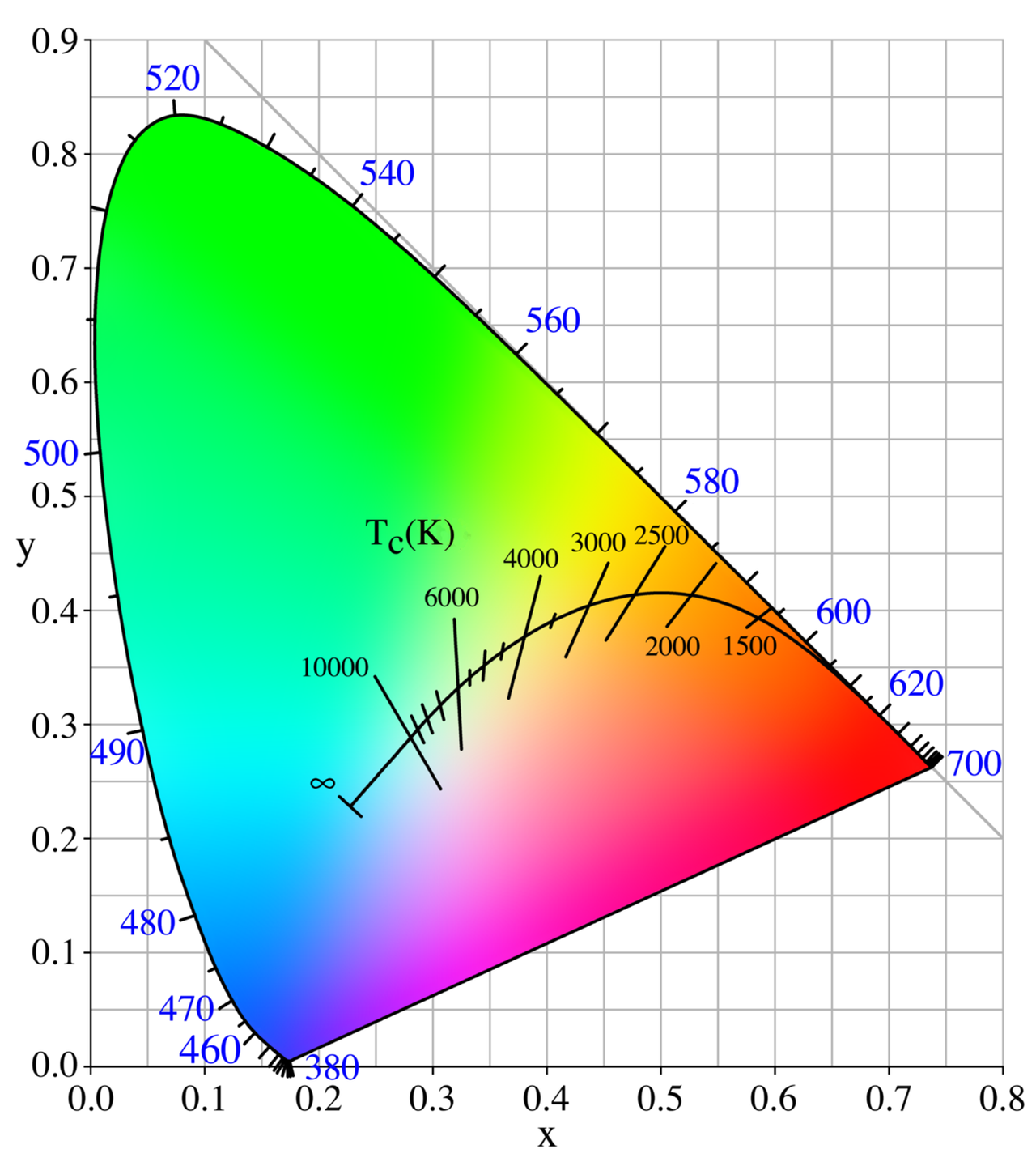
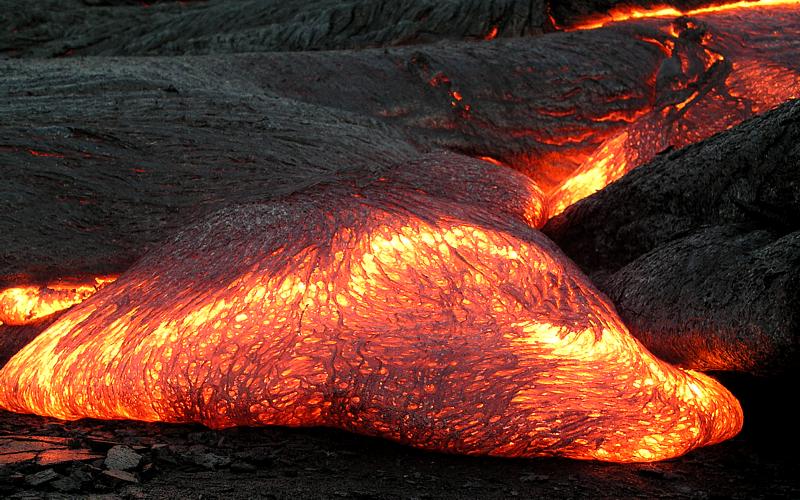
The defining features of blackbody radiation are its universality and temperature dependence. The spectral shape is not determined by chemical composition but by temperature: as temperature rises, the total emitted power increases and the spectrum shifts toward shorter wavelengths. This shift explains why heated objects progress from faint red glow to bright white as they become hotter. Total radiated power per unit area follows a specific temperature law, and the spectrum has a single peak whose position moves with temperature.
Fundamental laws
- Planck's law — gives the spectral energy density (power per unit area per unit wavelength or frequency) for an ideal blackbody. It resolved the ultraviolet catastrophe that classical physics predicted by introducing quantized energy exchange.
- Wien's displacement law — states that the wavelength at which the emission is strongest is inversely proportional to temperature; higher temperatures have peaks at shorter wavelengths.
- Stefan–Boltzmann law — states that the total energy emitted per unit surface area across all wavelengths is proportional to the fourth power of absolute temperature.
- Kirchhoff's law of thermal radiation — relates emission and absorption: for an object in thermal equilibrium, emissivity equals absorptivity at each wavelength.
History and theoretical development
Experimental study of thermal radiation in the 19th century, including cavity-emission measurements, led to precise spectral data that classical models could not explain. In 1900 Max Planck proposed a formula that matched observations by assuming energy is exchanged in discrete quanta. Planck's hypothesis is widely regarded as the origin of quantum theory. Subsequent work by Wien, Stefan, Boltzmann and Kirchhoff established the empirical and theoretical framework still used today.
Applications and examples
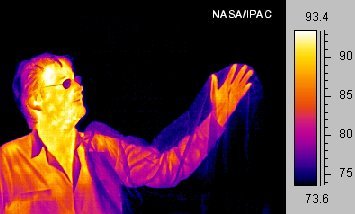
Blackbody concepts underpin many areas of physics and engineering. Stars approximate blackbodies, so their temperature and luminosity are inferred from spectra. The cosmic microwave background is closely modeled as a nearly perfect blackbody, providing crucial cosmological information. In technology, thermal imaging, furnace design, and radiation thermometry rely on blackbody calibration sources. Practical reference materials and simulation tools are available for further study: further reading and resources and data and computational tools.
Distinctions and notable facts
Actual objects rarely behave as perfect blackbodies; metals and coatings can have strongly wavelength-dependent emissivity. Nevertheless, the blackbody ideal provides a benchmark for comparing radiative properties. Planck's resolution of spectral discrepancies was a turning point in physics because it required a departure from classical continuum energy assumptions. Understanding blackbody radiation remains essential for interpreting astronomical observations, designing thermal systems, and grasping foundational quantum ideas.
Related articles
Author
AlegsaOnline.com Blackbody Radiation Leandro Alegsa
URL: https://en.alegsaonline.com/art/11991