
Bohr model of the atom
Early quantum model that introduced quantized electron orbits to explain atomic spectra, especially the hydrogen lines; historically important though superseded by modern quantum mechanics.
Overview
The Bohr model is an early atomic model that introduced the idea of quantized electron orbits around a compact nucleus. Developed to bridge classical physics and emerging ideas in quantum mechanics, it pictured the atom as electrons moving in circular paths with certain allowed energies. The model is most accurate for the hydrogen atom and for hydrogen-like ions and played a decisive role in explaining why atoms emit light at discrete wavelengths.
Image gallery
1 Image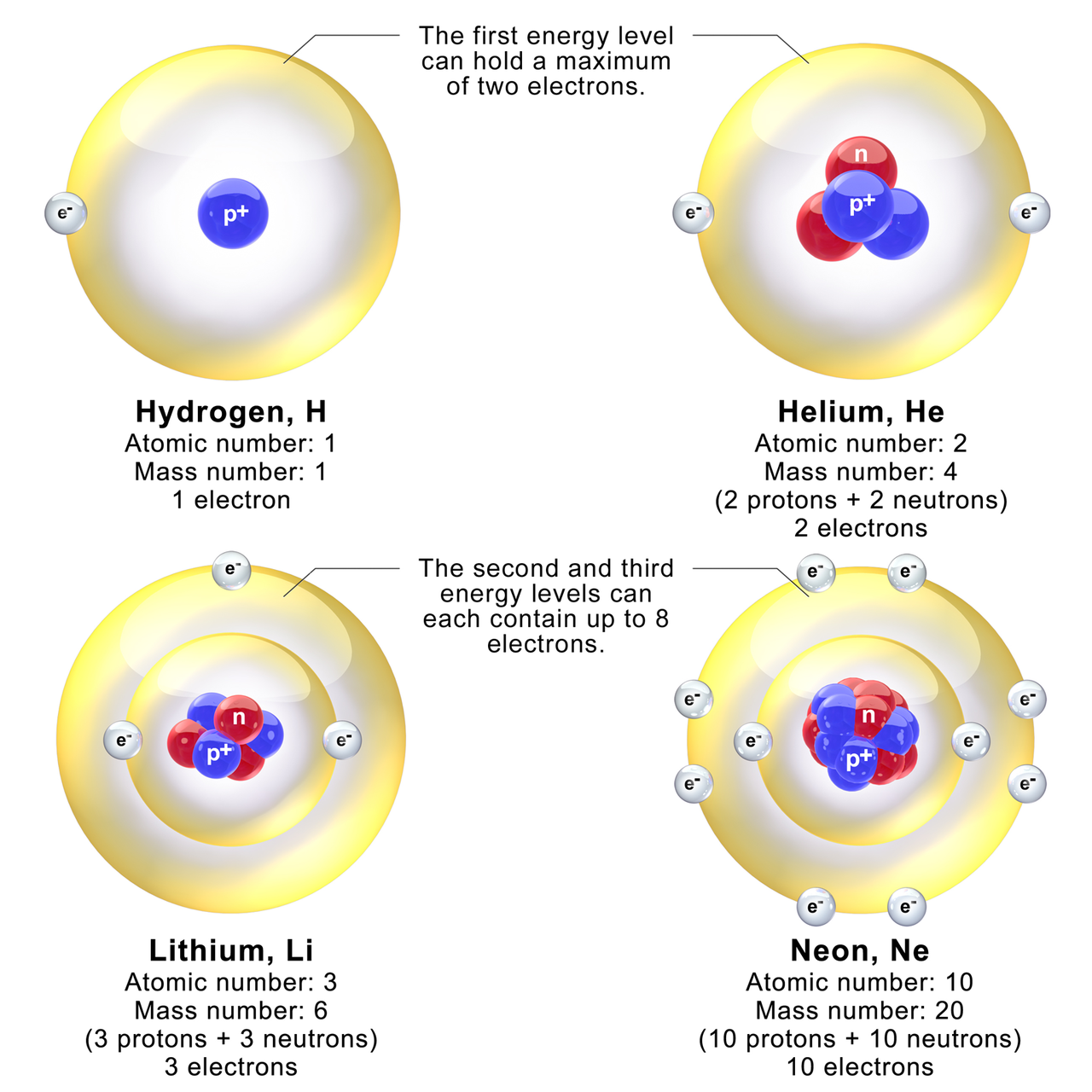
Key postulates and predictions
Bohr proposed several simple assumptions that departed from classical expectations. In place of continuous energy values he introduced discrete energy levels; electrons could inhabit only those levels and would emit or absorb energy when jumping between them. Angular momentum was quantized so that only orbits with an integral number of Planck's constant units were permitted. These ideas lead directly to a formula for the allowed energies and therefore to predicted spectral lines, matching the observed pattern of the hydrogen emission spectrum.
- Quantized orbits: electrons occupy fixed orbits with specific energies.
- Energy transitions: radiation is emitted or absorbed when an electron moves between levels.
- Correspondence: for large quantum numbers classical predictions are approached.
Historical context and development
The model was proposed in 1913 by Niels Bohr as an extension of the nuclear atom revealed by Rutherford's scattering experiments. At the time, experimental data such as Balmer's and Rydberg's formulas for visible spectral lines lacked a clear theoretical origin; Bohr's hypotheses produced those formulas from simple assumptions about quantized energy. The Bohr model helped catalyze the transition from classical atomic theory to the full wave mechanics that followed in the 1920s.
Uses, successes, and limitations
Its principal success was explaining the pattern and frequency of spectral lines for hydrogen and offering an intuitive picture of discrete atomic energies. The model also provided groundwork for later concepts (for example, quantum numbers and selection rules). However, it has clear limits: it cannot account accurately for atoms with more than one electron, it omits electron spin and relativistic fine structure without ad hoc corrections, and it lacks the probabilistic electron cloud description given by wave mechanics (Schrödinger and Heisenberg formulations).
Legacy and distinguishing facts
Although replaced by modern quantum theory, the Bohr model remains a standard teaching tool because it captures key quantum ideas with minimal mathematics and explains why atomic spectra are discrete. It illustrates an important historical step: the move from continuous classical orbits to discrete quantum states. For introductory purposes and for hydrogen-like systems it still provides accurate, easily computed results and intuition about atomic behavior.
Further reading and resources about the model and its role in the development of modern atomic theory are available in textbooks and online summaries; introductory treatments often link the Bohr picture to the more complete wave-mechanical view to show where approximations arise and how they are corrected in later theories. See also introductory materials on quantum mechanics, historical surveys in physics, and specific entries about the atom, hydrogen, and atomic spectra such as the hydrogen emission spectrum.
For biographical background on the scientist who formulated the model, consult resources about Niels Bohr.
Questions and answers
Q: What is the Bohr model?
A: The Bohr model is a model of the atom proposed by Niels Bohr, used in quantum mechanics.
Q: Which branch of physics does the Bohr model belong to?
A: The Bohr model belongs to a branch of physics called quantum mechanics.
Q: Is the Bohr model applicable to all atoms?
A: No, the Bohr model is only useful when discussing the behavior of a hydrogen atom.
Q: What is the significance of the Bohr model in describing the hydrogen emission spectrum?
A: The Bohr model is extremely useful in describing the hydrogen emission spectrum.
Q: Who proposed the Bohr model?
A: The Bohr model was proposed by Niels Bohr.
Q: What is quantum mechanics?
A: Quantum mechanics is a branch of physics that studies the behavior of matter and energy at a very small scale.
Q: What is the hydrogen emission spectrum?
A: The hydrogen emission spectrum is the spectrum of light emitted by excited hydrogen atoms as they return to their ground state.
Related articles
Author
AlegsaOnline.com Bohr model of the atom Leandro Alegsa
URL: https://en.alegsaonline.com/art/12706