
Eugene Parker: pioneer of solar wind theory and coronal physics
Biography and scientific contributions of Eugene N. Parker, the astrophysicist who predicted the supersonic solar wind, the Parker spiral, and proposed nanoflares for coronal heating.
Eugene N. Parker (1927–2022) was an American astrophysicist whose ideas reshaped how scientists understand the Sun and its influence on the solar system. In the 1950s he proposed that the Sun continuously emits a stream of charged particles that becomes supersonic as it expands outward; this concept, now called the solar wind, became a foundational element of space physics. His work established theoretical connections between solar plasma flows and magnetic fields that affect planetary magnetospheres, spacecraft, and space weather.
Image gallery
10 Images


Key concepts and theories
Parker formulated several enduring concepts. He showed how an expanding, magnetized solar atmosphere leads naturally to a spiral-shaped interplanetary magnetic field, commonly known as the Parker spiral. This geometry explains the observed orientation of magnetic fields measured by spacecraft and underlies models of particle transport and solar-terrestrial coupling. He also suggested that coronal heating might result from innumerable small reconnection events or "nanoflares," providing a mechanism to sustain the Sun's hot outer atmosphere.
- Solar wind: continuous, supersonic outflow of plasma from the Sun; see discussion at solar wind overview.
- Corona and heating: ideas about small-scale energy release as a source of coronal heat; see solar corona.
- Academic posts: early faculty appointment at the University of Utah and a long career at the University of Chicago.
Development and reception
Parker published theoretical analyses in the 1950s that met initial skepticism because the notion of a steady, supersonic outflow conflicted with prevailing expectations about a static solar atmosphere. Observational confirmation came with spacecraft measurements in the late 1950s and 1960s, which detected continuous particle streams and magnetic-field orientations consistent with Parker's predictions. His 1958 paper, often cited in histories of heliophysics, provided the mathematical basis for the dynamics of the interplanetary medium.
The ideas about nanoflares addressed the long-standing coronal heating problem: why the Sun's corona is orders of magnitude hotter than its visible surface. While nanoflares have not replaced other heating theories entirely, they remain a viable and influential component of modern models and observational campaigns.
Impact, honors, and legacy
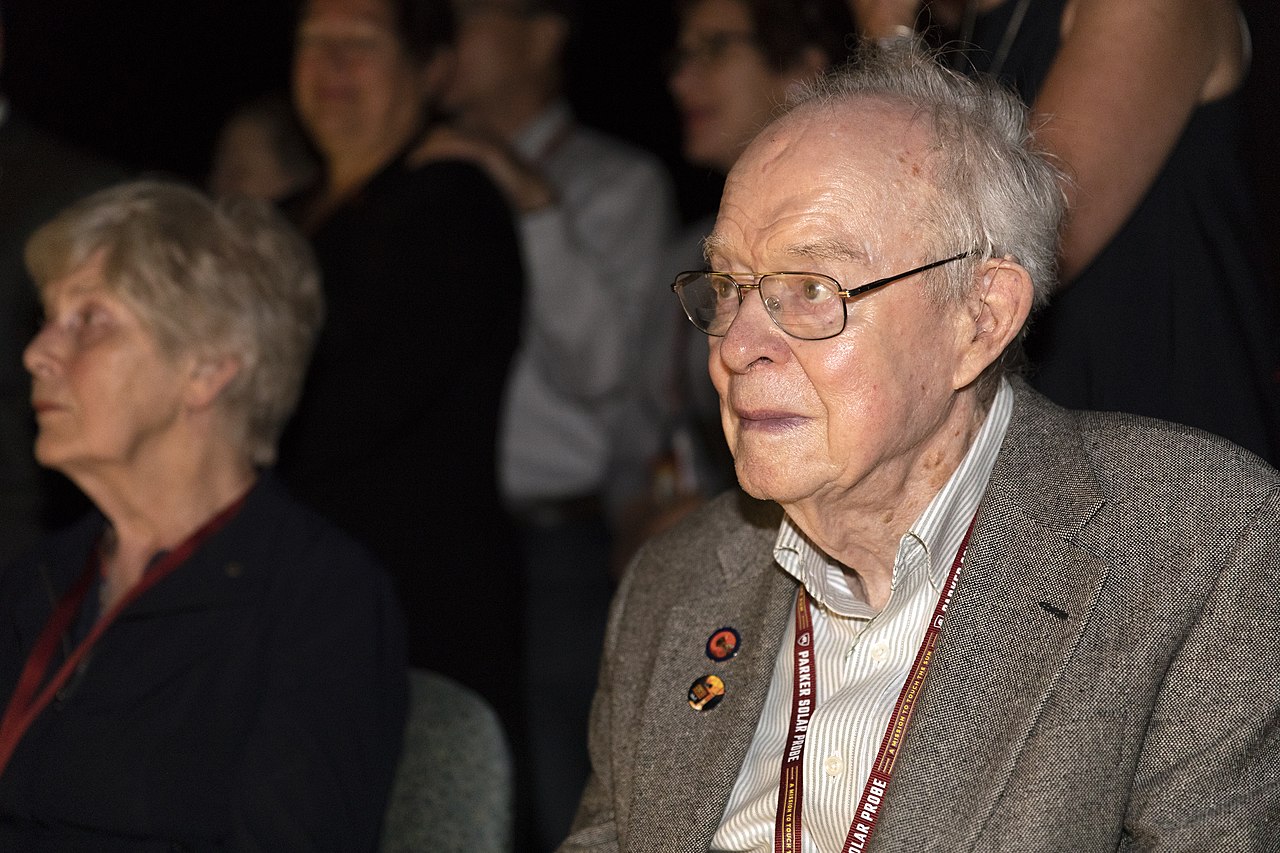
Parker's theories are central to contemporary studies of space weather, heliospheric structure, and plasma astrophysics. His name was given to NASA's mission originally called Solar Probe Plus; the spacecraft was renamed Parker Solar Probe by NASA, the first time a NASA spacecraft honored a living person. He was elected to the National Academy of Sciences and received major recognitions such as the American Physical Society's Medal for Exceptional Achievement in Research.
- Major contributions: solar wind theory, Parker spiral, nanoflare hypothesis.
- Selected honors and milestones: election to the National Academy of Sciences (1967), naming of the Parker Solar Probe, and APS medal (2018).
Eugene Parker remained professionally active for decades as a researcher and teacher, influencing generations of scientists. He spent his later career in Chicago and passed away at age 94 from complications related to Parkinson's disease in a retirement home in Hyde Park, Chicago, Illinois. His theoretical insights continue to guide observations and missions that probe the Sun's atmosphere and the space environment throughout the solar system.
Further reading and resources: historical accounts and mission pages provide more detail on the development and testing of Parker's ideas; see institutional pages and outreach summaries connected to his work via sources such as solar wind overview, coronal studies, and mission summaries like Parker Solar Probe.
Related articles
Author
AlegsaOnline.com Eugene Parker: pioneer of solar wind theory and coronal physics Leandro Alegsa
URL: https://en.alegsaonline.com/art/118738
Sources
- theguardian.com : "Nasa's hotly anticipated solar mission renamed to honour astrophysicist Eugene Parker"
- news.uchicago.edu : "Award honors Prof. Eugene Parker's lifetime of physics research"