
David Easton — Political Scientist and Architect of Systems Theory
David Easton (1917–2014) was a Canadian–American political scientist best known for introducing a systems approach to political analysis and for shaping mid-20th-century political science.
David Easton (June 24, 1917 – July 19, 2014) was a prominent Canadian‑born, later American political scientist whose work helped to reframe the study of politics in the mid‑20th century. He served as a Distinguished Research Professor in the Department of Political Science at the University of California, Irvine and remained an influential figure in the field until his death in Irvine, California.
Image gallery
2 Images
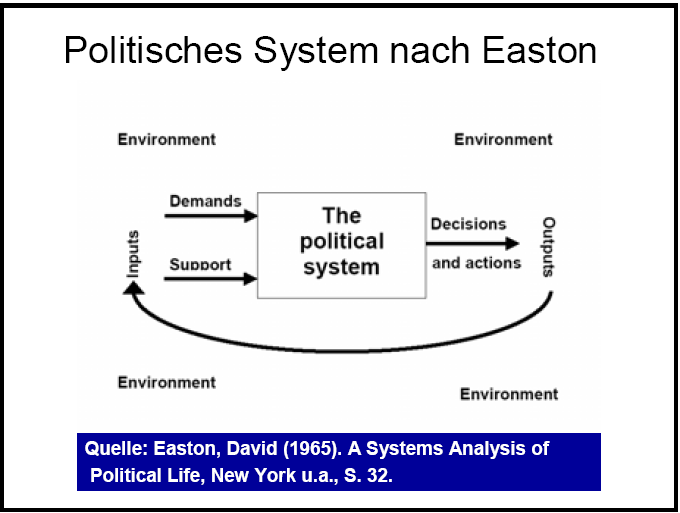
Overview of his approach
Easton is best known for promoting a systems perspective in political analysis. Rather than treating political phenomena as isolated events, he described politics as a system that receives inputs from its environment, processes those inputs through governmental and institutional structures, and produces outputs in the form of authoritative decisions and policies. His formulation emphasized feedback loops, the boundaries between a political system and its environment, and the role of political support and demands in sustaining a system.
Key concepts and contributions
Among Easton’s enduring contributions is a concise definition of politics as the "authoritative allocation of values," which reframed longstanding normative debates into an analytical problem. His systems model distinguishes between inputs (such as public demands and support), the conversion processes of institutions, outputs (decisions, laws, policies), and feedback mechanisms that inform future inputs. This conceptual toolkit helped scholars move toward comparative, empirical, and theoretically grounded studies of political life.
Work and influence
Easton authored several widely read texts and essays that disseminated his ideas to a generation of political scientists. His emphasis on conceptual clarity and on linking normative concerns to empirical study contributed to the behavioral revolution in political science, which stressed systematic observation and theory testing. His systems approach was adapted across subfields including comparative politics, public policy, and political development.
Reception and legacy
While many scholars embraced Easton’s framework for its clarity and breadth, some critics argued that the systems model could be too abstract or mechanistic, glossing over power asymmetries, culture, and historical change. Nonetheless, Easton’s work remains a staple in introductory treatments of political theory and methodology, and his influence persists in how researchers conceptualize the relationships among institutions, citizens, and policy outcomes.
Context and notable facts
- He combined conceptual rigor with a focus on empirical research that shaped mid‑century political science.
- Easton’s vocabulary—inputs, outputs, feedback, support, demands—continues to appear in academic and pedagogical settings.
- He spent his later career at the University of California, Irvine, where he held the title of Distinguished Research Professor.
Taken together, Easton’s ideas provided a durable framework for thinking about political systems as dynamic entities embedded in broader social and environmental contexts. His passing in 2014 marked the end of a long career that left a visible imprint on the discipline.
Related articles
Author
AlegsaOnline.com David Easton — Political Scientist and Architect of Systems Theory Leandro Alegsa
URL: https://en.alegsaonline.com/art/117263
Sources
- faculty.uci.edu : David Easton, Distinguished Research Professor, Political Science School of Social Sciences