
Billy Bathgate — novel by E. L. Doctorow
A concise encyclopedia entry on E. L. Doctorow's 1989 novel Billy Bathgate: overview, themes, style, awards, publication history, and its film adaptation and legacy.
Billy Bathgate is a 1989 historical novel by American author E. L. Doctorow. Written in a first-person voice, it recounts the coming-of-age story of Billy "Bathgate" Behan, a teenager who becomes the gofer and surrogate son to the real-life gangster Dutch Schultz. The book blends fact and fiction to evoke New York City's criminal underworld of the 1930s.
Image gallery
2 Images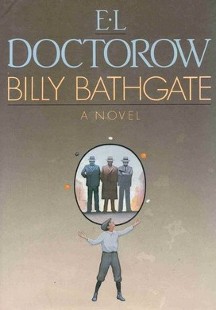

Overview
The narrative is delivered by Billy as a retrospective, mixing youthful naïveté with reflective hindsight. Doctorow reconstructs events around organized crime, political influence, and moral ambiguity, using a literary style that foregrounds voice and atmosphere over straightforward chronological history. The novel's title comes from the protagonist's adopted surname.
Themes and style
Billy Bathgate explores themes of identity, loyalty, power, and the seductions of criminal celebrity. Doctorow often compresses historical detail into scenes that emphasize character psychology and social texture. The prose alternates plain narrative with moments of poetic description, and it deliberately blurs the line between documentary fact and invented inner life.
Publication, awards, and reception
Published in 1989, the novel earned significant critical recognition. It won the 1990 PEN/Faulkner Award for Fiction and the William Dean Howells Medal, and it received the National Book Critics Circle award for fiction. It was also a finalist or runner-up for major honors, including the Pulitzer Prize and the National Book Award. Critics praised Doctorow's narrative voice though some debated the balance between historical reconstruction and imaginative invention.
Notable characters and historical basis
- Billy "Bathgate" Behan — the narrator and young protagonist, fictionalized to convey initiation into crime.
- Dutch Schultz — modeled on the real mobster, depicted as charismatic, volatile, and dangerous; see background on Dutch Schultz.
- Supporting figures include lieutenants, rivals, and figures of law enforcement and politics whose names and roles are reshaped for narrative purposes.
Adaptations and legacy
The novel was adapted into a 1991 film that brought wider public attention to Doctorow's work, and it remains a commonly cited example of late 20th-century American historical fiction. For readers interested in Doctorow's broader oeuvre and his approach to mixing history and invention, consult the author's bibliography and critical essays on his narrative technique at further resources.
Billy Bathgate stands as both a period portrait and a study of storytelling: it asks how personal memory and cultural myth shape our understanding of violent public lives. For introductions to the book and to discussions of its historical context, see recommended guides and scholarly overviews linked here and elsewhere.
Related articles
Author
AlegsaOnline.com Billy Bathgate — novel by E. L. Doctorow Leandro Alegsa
URL: https://en.alegsaonline.com/art/11529
Sources
- bookcritics.org : "All Past National Book Critics Circle Award Winners and Finalists"
- penfaulkner.org : "Past Winners & Finalists"
- artsandletters.org : "The William Dean Howells Medal"
- pulitzer.org : 1990 Pulitzer Prize Nominated Finalists (Runners Up)
- nationalbook.org : "National Book Awards - 1989"
- articles.latimes.com : "BILLY BATHGATE by E.L. Doctorow (Harper & Row: $5.95)"