
Alexander Stepanovich Popov — Russian physicist and early radio researcher
Alexander S. Popov (1859–1905) was a Russian physicist who developed and publicly demonstrated an early radio wave detector. He is celebrated in Russia for pioneering wireless detection and signaling.
Alexander Stepanovich Popov (Александр Степанович Попов) (born March 16, 1859 — died January 13, 1906; born O.S. March 4, died O.S. December 31; Old Style/New Style dates) was a Russian physicist and inventor who performed some of the earliest experiments in detecting electromagnetic waves. Working at the turn of the 20th century, he built apparatus that converted distant electromagnetic disturbances into audible or telegraphic signals, and he is often remembered for adapting those methods to practical signaling.
Image gallery
10 Images



Work and experiments
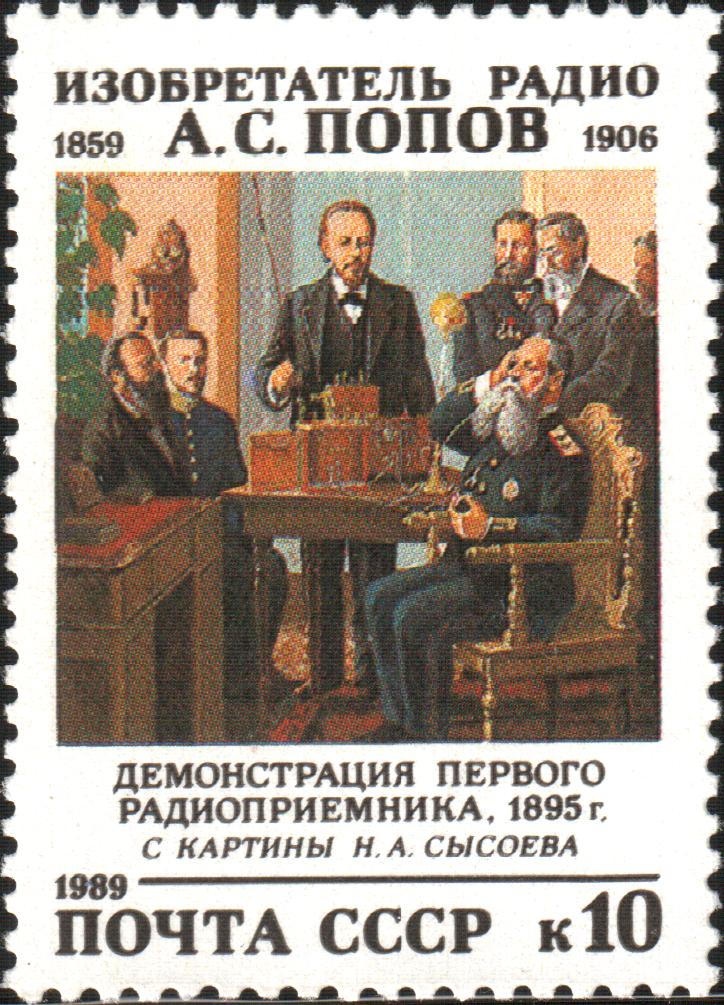
Popov's laboratory work combined interests in physics and meteorology. He developed a receiving system that used a vertical antenna and a sensitive detector (a coherer-like device) to respond to impulses of electromagnetic energy. In demonstrations he showed how the apparatus could register atmospheric electrical discharges and, subsequently, deliberately produced wireless impulses. These experimental systems exploited the same basic phenomena that later came to be called radio waves.
Public demonstrations and development
In the mid-1890s Popov presented his detector and its operation to scientific audiences in Russia. His presentations emphasized the instrument's use as a lightning detector and a way to sense distant electrical disturbances; he and his colleagues soon adapted the setup for signaling between stations. Unlike some contemporaries, Popov did not move to secure a personal monopoly on the method — he did not file a formal patent for his receiving apparatus — and his work remained largely within Russian scientific institutions.
Legacy and distinctions
Popov is a prominent figure in the history of early wireless communication, especially in Russia and several neighboring countries where he is honored as a pioneer. Annual commemorations and memorials celebrate his contributions and teaching. Historically, the question of priority in inventing practical wireless telegraphy involves multiple inventors and inventing paths; Popov's experiments are recognized as one important, independent line of development.
Notable facts
- Popov combined meteorological needs (lightning detection) with laboratory physics to design early receivers.
- He demonstrated the conversion of distant electromagnetic disturbances into signals that could be registered or heard.
- His work predates widespread commercial radio systems but was not commercialized through patents.
- He remains a national scientific figure in Russia and is taught as an early pioneer of wireless technology.
For readers seeking primary sources or detailed technical descriptions, consult specialized histories of electromagnetism and wireless telegraphy; many treatments place Popov alongside other late-19th-century experimenters who helped turn Maxwell's theory into practical communication systems.
Related articles
Author
AlegsaOnline.com Alexander Stepanovich Popov — Russian physicist and early radio researcher Leandro Alegsa
URL: https://en.alegsaonline.com/art/113676
Sources
- ieee.org : "Early Radio Transmission Recognized as Milestone"
- commons.wikimedia.orgAlexander_Stepanovich_Popov.html : Alexander Stepanovich Popov