
87 Sylvia — a large Cybele-group asteroid with two moons
87 Sylvia is a large, dark asteroid in the outer main belt (Cybele group). It was the first asteroid found to have more than one moon, enabling direct measurements of mass and density.
Overview
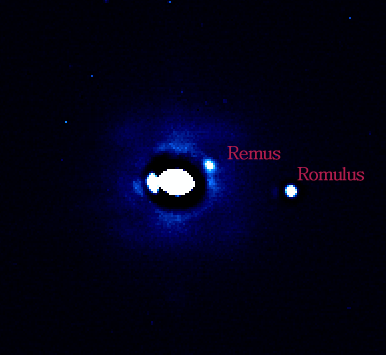
87 Sylvia is a prominent asteroid located in the outer portion of the asteroid belt. It orbits beyond the belt's middle region and is commonly described as part of the Cybele population. As one of the larger belt objects, Sylvia has attracted attention because it possesses a system of natural satellites — the first asteroid discovered to have more than one moon.
Image gallery
2 Images
Physical characteristics
Sylvia appears dark and primitive, consistent with carbon-rich surfaces found on many outer-belt asteroids. Its shape is irregular rather than perfectly spherical, and measurements of the orbital motion of its moons indicate a relatively low bulk density. These properties suggest a porous internal structure, often interpreted as a rubble-pile assembled from fragments after past collisions.
Discovery and satellites
Discovered in the 19th century, Sylvia was later revealed to host multiple companions through improved observational techniques such as adaptive optics and high-resolution imaging. The presence of two moons provided the opportunity to calculate the mass of Sylvia directly from their orbital dynamics, a rare advantage for objects in the asteroid belt.
Orbit and classification
Sylvia orbits in the outer main belt and is usually grouped with the Cybele group, a set of asteroids occupying stable orbits beyond the main concentration of belt bodies. It is also described more generally as a large member of the main belt, residing at greater heliocentric distance than many typical belt asteroids.
Scientific importance
The discovery of multiple satellites around Sylvia has had several scientific benefits: it allowed astronomers to determine the asteroid's mass and therefore estimate its density; it offered insight into binary and multiple-body formation mechanisms in the early solar system; and it provided a laboratory for studying gravitational interactions among small bodies.
Notable facts
- Sylvia was the first asteroid known to have more than one moon, a landmark discovery for planetary astronomy.
- Its satellites' orbits enable precise dynamical studies that constrain internal structure and composition.
- As a member of the Cybele group, Sylvia helps define the population of outer-belt, dark bodies important for understanding solar system evolution.
Related articles
Author
AlegsaOnline.com 87 Sylvia — a large Cybele-group asteroid with two moons Leandro Alegsa
URL: https://en.alegsaonline.com/art/113092
Sources
- adsabs.harvard.edu : "Discovery of the triple asteroidal system 87 Sylvia"
- johnstonsarchive.net : Data sheet compiled by W. R. Johnston
- rni.helsinki.fi : "Models of Twenty Asteroids from Photometric Data"
- psi.edu : PDS lightcurve data
- psi.edu : Supplemental IRAS Minor Planet Survey
- psi.edu : PDS spectral class data
- adsabs.harvard.edu : Minor Planet (87) Sylvia