
480 BC
A calendar year notable for major events in the Greco-Persian Wars, including Thermopylae and Salamis, and for developments across the Mediterranean and East Asia during the late Archaic period.
480 BC is a year commonly referenced in classical chronologies and recorded under the pre-Julian Roman calendar (see source). It falls within the larger era conventionally labeled "5th century BC" and is marked by decisive military, political, and cultural events that shaped the eastern Mediterranean and beyond. Modern historians reconstruct the year's chronology from contemporary inscriptions, later annalists and archaeological evidence.
Image gallery
1 Image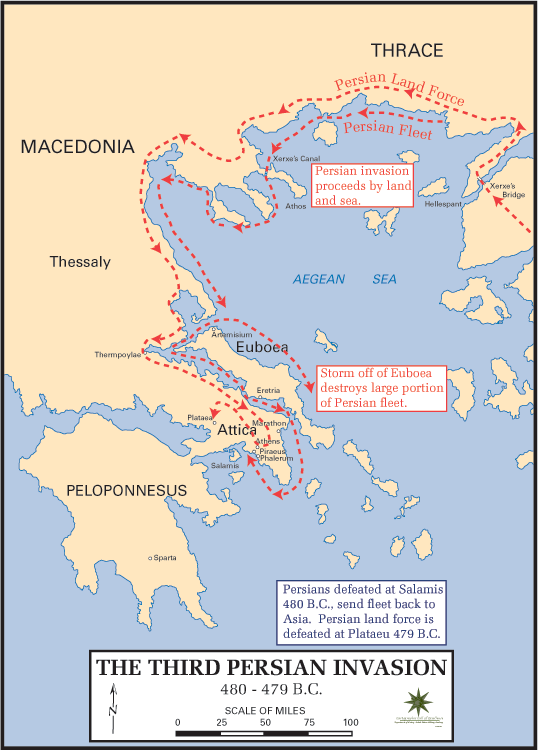
Greco-Persian Wars
The year is best known for the major campaigns of the Persian invasion led by King Xerxes I of Persia. Xerxes advanced into Greece with a large land force and a supporting fleet. Greek city-states formed ad hoc coalitions, most prominently Athens and Sparta, to resist the invasion. Several connected engagements defined the campaign:
- Thermopylae: A famous delaying stand in a narrow pass by a small Greek force, including a Spartan contingent under King Leonidas, which allowed other Greek forces time to prepare.
- Artemisium: Naval clashes in the same time frame tested Persian sea power against a Greek fleet attempting to guard the coast and supply lines.
- Salamis: A decisive naval battle near the island of Salamis in which the Greek fleet, led by Athenian commanders, defeated the larger Persian fleet, forcing Xerxes to withdraw part of his force.
Following the land victories at Thermopylae, Persian forces entered and largely sacked the city of Athens, which had been largely evacuated. The combined effect of the naval check at Salamis and continued resistance on land shifted the strategic balance, setting the stage for later Greek counter-offensives.
Other regions and developments
Beyond the Persian-Greek confrontations, 480 BC falls within active periods in other cultural spheres. In the Italian peninsula the Roman Republic continued its early development under the pre-Julian calendar system, with local politics and conflicts shaping civic institutions. In China the late Spring and Autumn period saw competing states and intellectual ferment that would lead, within a few decades, into the Warring States era. Across the wider Near East and Mediterranean, trade, colonization and artistic exchange continued despite wartime disruption.
Significance and legacy
The events of 480 BC—especially the battles of Thermopylae and Salamis—have had an outsized place in later cultural memory, politics and historiography. They are cited in studies of military strategy, in national mythmaking, and in literature and art. The year is also a convenient reference point for scholars studying chronology, calendars and the interaction of Greek, Persian and other ancient societies.
For overview material on the Roman calendar that labels years like this one, see the pre-Julian Roman calendar entry here. Research into 480 BC combines literary sources from antiquity with archaeology and numismatic evidence to reconstruct a still-discussed but unevenly documented chapter of ancient history.
Related articles
Author
AlegsaOnline.com 480 BC Leandro Alegsa
URL: https://en.alegsaonline.com/art/112918