
52 BC: Crisis in Rome and Caesar’s Victory in Gaul
Year 52 BC, during the late Roman Republic, is noted for the political violence in Rome, Pompey's return to prominence, and Julius Caesar's decisive victory over Vercingetorix at Alesia.
Overview
52 BC falls in the closing decades of the Roman Republic. It is conventionally dated using the Anno Domini system today, but contemporaries identified the year by the names of the consuls and by counts since the founding of the city. The year is remembered for a combination of intense domestic political disorder in Rome and a decisive military campaign in Gaul that helped change the balance of power among Rome’s leading figures.
Image gallery
2 Images
How the year was named
Romans commonly referred to years by the two serving consuls; contemporary records call 52 BC the "Year of the Consulship of Pompeius and Scipio." Another old method counted years from the foundation of Rome, giving a designation such as Ab urbe condita. Modern chronology uses the Anno Domini system, while the original civic calendar was the pre-Julian Roman calendar, part of a broader set of timekeeping practices known collectively as a calendar era.
Major events
- Political violence in Rome: The murder of a popular politician intensified street fighting and rioting, damaging public buildings and unsettling the Senate. The crisis produced a demand for strong leadership to restore order.
- Pompey’s role: The turbulence elevated Gnaeus Pompeius (Pompey) into a central position as a restorer of public order and a dominant political figure during the year.
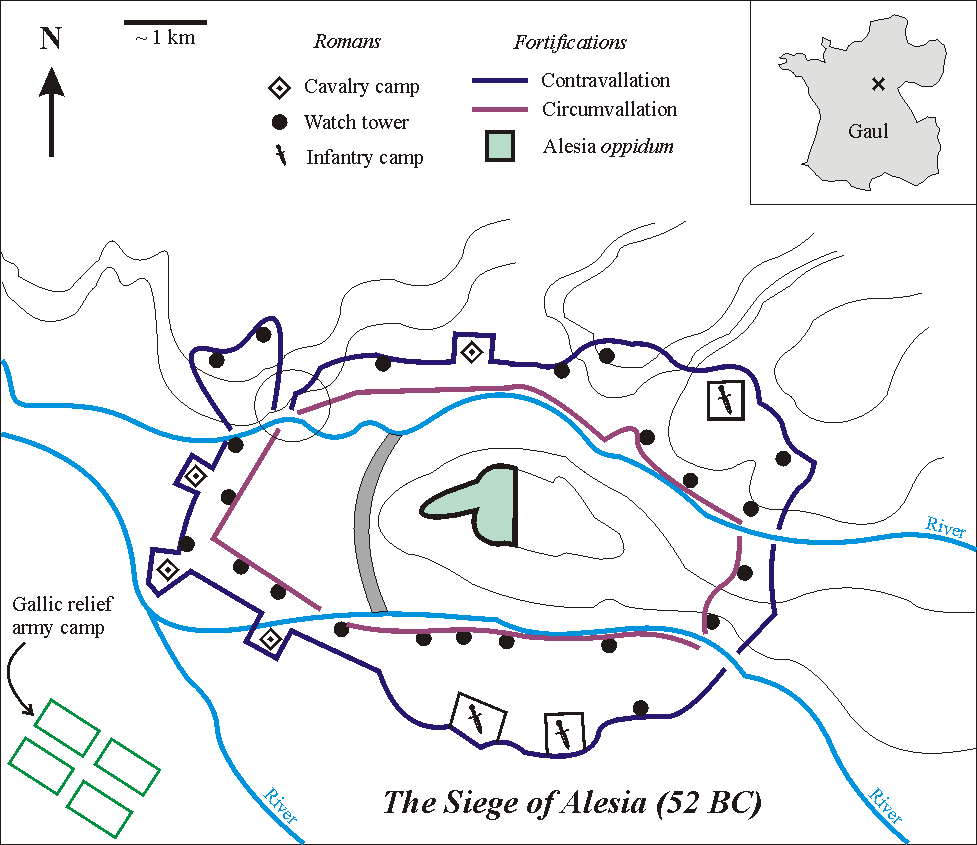
- Gallic War and Alesia: In Gaul, Julius Caesar confronted a broad rebellion led by Vercingetorix. The campaign culminated in the siege of Alesia, where Roman engineering — including lines of circumvallation and contravallation — and tactical coordination secured a Roman victory that effectively ended organized Gallic resistance.
Consequences and significance
The suppression of the Gallic revolt greatly expanded Rome’s practical control over Gaul and enhanced Caesar’s prestige and military resources. At the same time, violent factionalism in the city and the prominence of powerful generals like Pompey signaled the erosion of traditional Republican norms. Those strains contributed to the sequence of events that would lead to civil war later in the decade.
Context and notable facts
52 BC exemplifies how military success abroad and political disorder at home interacted in the late Republic. The combination of charismatic military commanders, popular unrest, and institutional stress made the year a touchstone for historians studying Rome’s transition from republican government toward imperial rule. Key themes include the use of public violence for political ends, the mobilization of private armies, and the role of large-scale engineering and logistics in Roman warfare.
Further reading
For context on Roman timekeeping and naming of years, see introductions to the pre-Julian Roman calendar and the practice of dating by consuls. Broader surveys of the late Republic place 52 BC among the critical moments that reshaped Roman politics and military command structures.
Questions and answers
Q: What year was it according to the pre-Julian Roman calendar?
A: It was the year of the Consulship of Pompeius and Scipio.
Q: When did the Anno Domini calendar era become the most common method of naming years in Europe?
A: The Anno Domini calendar era became the most common method of naming years in Europe from the early medieval period.
Q: Why is the year 52 BC commonly known as 52 BC?
A: The year 52 BC is commonly known as 52 BC because of the Anno Domini calendar era.
Q: What is the Anno Domini calendar era?
A: The Anno Domini calendar era is a calendar era that is widely used in the Western world and it begins with the birth of Jesus Christ.
Q: How many years have passed since 52 BC to the present day according to the Gregorian calendar?
A: As of 2021, approximately 2073 years have passed since 52 BC according to the Gregorian calendar.
Q: What is meant by the term "Ab urbe condita"?
A: "Ab urbe condita" is a Latin term that means "from the founding of the city" and it refers to the traditional founding of Rome by Romulus in 753 BC.
Q: How long has the Anno Domini calendar era been used?
A: The Anno Domini calendar era has been in use since the early medieval period and is still in use today.
Related articles
Author
AlegsaOnline.com 52 BC: Crisis in Rome and Caesar’s Victory in Gaul Leandro Alegsa
URL: https://en.alegsaonline.com/art/112963