
2001 Anthrax Attacks (Amerithrax) — mailed Bacillus anthracis letters in the U.S.
Summary of the 2001 Amerithrax letter attacks in the United States: timeline, agent and clinical effects, investigation, public‑health and postal responses, controversies and legacy.
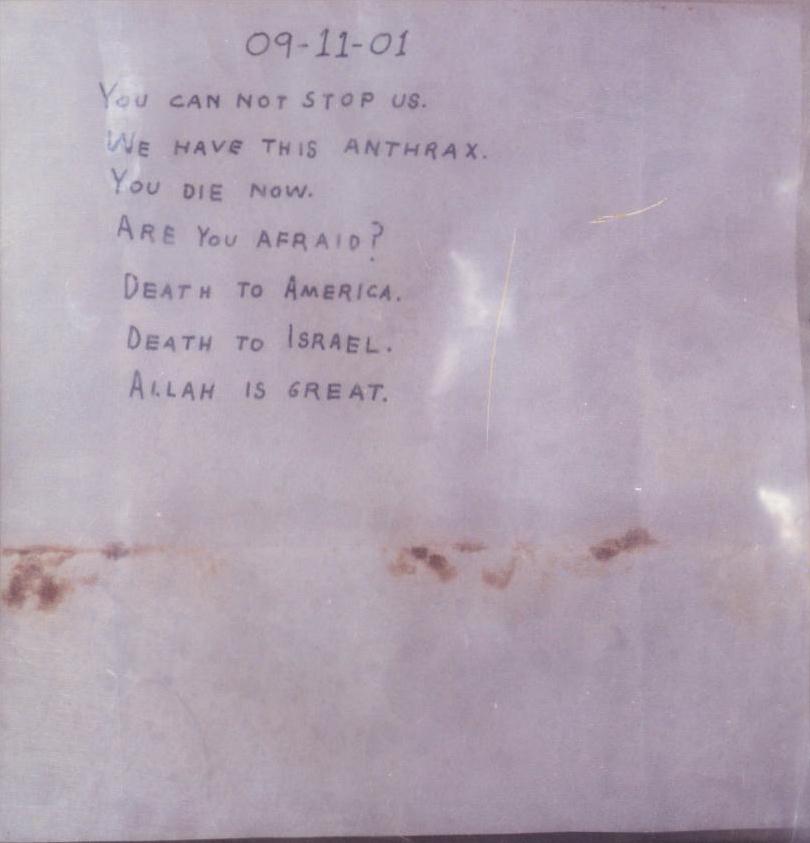
The 2001 anthrax attacks, commonly called "Amerithrax," were a series of bioterror incidents in the United States in which envelopes containing spores of the bacterium Bacillus anthracis were mailed to media organizations and to U.S. Senate offices. The letters were sent in mid‑September and October 2001, shortly after the September 11 terrorist attacks, and produced widespread alarm, illness, several deaths and long‑term changes to public health, mail handling and biodefense policy. Overview
Image gallery
10 Images




Timeline and targets
Letters with a fine, powdered form of anthrax were mailed to multiple news outlets and to at least two U.S. senators. Postal facilities that handled those items became secondary exposure sites. The exposures caused infections among people who opened the letters, postal workers who handled contaminated mail, and others who came into contact with tainted envelopes or cross‑contaminated material. In total, 22 people were infected and five died. The attacks led to building closures, large‑scale mail screening and decontamination operations. Targets and timeline
The agent and clinical effects
Bacillus anthracis produces dormant spores that can persist in the environment. Disease presentation depends on route of exposure; inhalational anthrax, which affects the lungs, was the most serious form seen in the 2001 incidents and can be rapidly fatal without prompt treatment. Public health authorities used antibiotics for post‑exposure prophylaxis and treatment and, in some instances, vaccination for high‑risk personnel. Clinical recognition, rapid laboratory diagnosis, and early antimicrobial therapy were critical to improved outcomes. Agent and clinical context
Investigation and forensic science
The Federal Bureau of Investigation led a complex inquiry known as "Amerithrax." Investigators used epidemiology, mail‑handling records and laboratory analyses to trace the origin of the spores. Microbial forensics, including genetic comparisons of Bacillus anthracis isolates and laboratory strain typing, played a central role; many of the mailed spores were related to a laboratory strain known as the Ames strain. After years of investigation the FBI named a government biodefense researcher as the prime suspect. Investigation methods
Legal outcomes and disputes
In 2008 the primary suspect, a U.S. biodefense researcher, died by suicide and was never prosecuted. The FBI later concluded that he was likely responsible, but that conclusion has been the subject of public debate and scientific scrutiny. Independent reviews and some scientists raised questions about aspects of the forensic evidence and about the strength of the case, and these disputes influenced subsequent practice in microbial forensics. Legal and scientific review
Public‑health and postal responses
- Health response: Local and federal health agencies coordinated case identification, prophylaxis distribution and laboratory confirmation, and provided guidance on antibiotic use and infection control. Public health actions
- Postal security: The U.S. Postal Service and other mail systems introduced new screening procedures, facility modifications and monitoring to reduce the risk from hazardous mail, and performed large decontamination projects at affected sites. Mail and facility measures
- Policy and research: The attacks accelerated funding and attention to biodefense research, improved laboratory biosafety and biosecurity practices, and prompted discussion about the governance of high‑consequence pathogens. Policy effects
Controversies, lessons and legacy
The Amerithrax events remain a widely studied case of small‑scale bioterrorism with outsized social, political and scientific consequences. Key controversies include interpretation of forensic data, the balance between rapid public communication and preserving investigative integrity, and how to secure dangerous materials while enabling legitimate research. Lessons learned influenced emergency preparedness, laboratory safety standards, the development of microbial forensics as a discipline, and procedures for handling suspicious mail. Continued discussion among scientists, legal experts and public officials reflects the complex intersection of science, policy and civil liberties highlighted by the attacks. Further reading and analysis
Because the anthrax letters combined a readily identifiable biological agent with routine distribution systems, the incidents prompted sustained changes to public health practice, postal operations and national biodefense strategy. They are remembered as a case study in response coordination, the limits of attribution, and the importance of resilient systems for detection and containment of biological threats.
Related articles
Author
AlegsaOnline.com 2001 Anthrax Attacks (Amerithrax) — mailed Bacillus anthracis letters in the U.S. Leandro Alegsa
URL: https://en.alegsaonline.com/art/112323
Sources
- npr.org : "Timeline: How The Anthrax Terror Unfolded"
- fbi.gov : "Amerithrax or Anthrax Investigation"