
1989 Tiananmen Square protests
A large pro-democracy movement in China in spring 1989, centered on Beijing's Tiananmen Square. It ended after a military crackdown in early June and remains a sensitive and contested event.
Overview
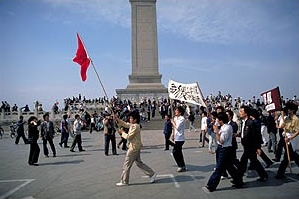
The 1989 Tiananmen Square protests were a series of demonstrations in the People's Republic of China that began in April and culminated in early June. Initially sparked by the death of a reform-minded official, the movement quickly broadened into nationwide calls for political reform, greater personal freedoms, and anti-corruption measures. Participants included students, intellectuals, workers and others; many of the most visible gatherings took place in Beijing's Tiananmen Square.
Image gallery
10 Images




Context and causes
The protests developed against a backdrop of economic change, rising social expectations, and debates within the Chinese Communist Party about reform. Public anger over corruption, inflation and limited political participation combined with inspiration from earlier pro-democracy movements elsewhere. The events are sometimes discussed in connection with the wider wave of political change in 1989, often referred to in international literature as part of the Revolutions of 1989.
Major events and timeline
- April: large gatherings began following the death of Hu Yaobang, a former party leader associated with reform.
- May: hunger strikes and sit-ins increased attention; Tiananmen Square became the focal point for sustained assembly.
- Late May–early June: the government declared martial law and ordered the military to clear central areas of Beijing.
- Early June: troops and armored units moved into urban areas; the confrontation ended with a violent clearance of protesters and bystanders.
Government response and terminology
The Chinese government suppressed the demonstrations using armed force and arrested participants and organizers. Within mainland China the official description has commonly been the term the June Fourth Incident or variations that frame it as a counterrevolutionary disturbance; outside China many commentators and governments characterize the episode as a massacre or crackdown. Exact details about casualties remain contested and politically sensitive.
Aftermath and legacy
The immediate aftermath included a tightening of political controls, arrests, trials, and a renewed emphasis on economic stability over political liberalization. Internationally, the events prompted diplomatic criticism and some sanctions. Within China the subject is heavily censored in official media and education; commemorations are restricted, while exiled communities and foreign scholars continue to study and remember the protests. The episode remains a key reference point in discussions about governance, human rights, and state-society relations in modern China.
For detailed primary sources and scholarly analysis, see contemporary reports and academic studies that document the protests, the government's response, and subsequent developments. Additional context on how the protests fit into late Cold War transformations is available through general histories of 1989 and the broader global changes of that period. Primary and secondary accounts offer varied perspectives on motives and outcomes.
Related articles
Author
AlegsaOnline.com 1989 Tiananmen Square protests Leandro Alegsa
URL: https://en.alegsaonline.com/art/112226
Sources
- economicexpert.com : "Tiananmen Square Protests Of 1989 students Government Chinese"
- foreignaffairs.org : "The Tiananmen Papers"