
Wicki–Hayden note layout
An isomorphic button layout for melodic instruments that gives identical fingering in every key; used on Hayden duet concertinas and some modern controllers, patented by Wicki (1896) and refined by Hayden (1986).
Overview
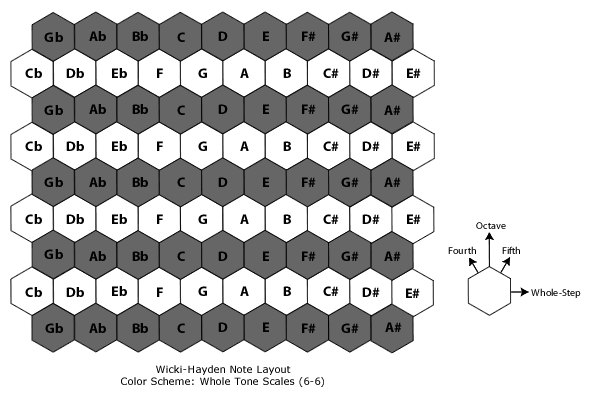
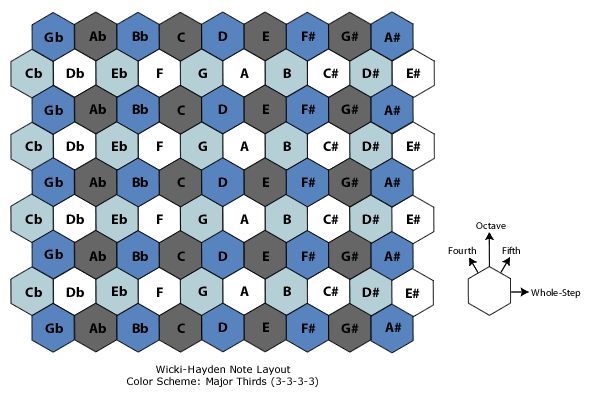
The Wicki–Hayden note layout is a two‑dimensional, isomorphic arrangement of pitches designed for buttoned or grid-style instruments. Its chief practical benefit is that the same fingerings produce the same intervals and scale patterns in every transposition, simplifying learning and improvisation. The layout is used by performers and instrument makers interested in efficient fingering and consistent geometry across keys, particularly on the Hayden duet concertina and on various electronic controllers and custom keyboards.
Image gallery
10 Images





Design and characteristics
Unlike the familiar staggered rows of a piano-style keyboard, the Wicki–Hayden layout arranges notes on a compact grid so that common musical intervals and chord shapes appear as identical geometric patterns wherever they occur. This isomorphic property means that a melodic shape, scale run, or chord fingering can be shifted across the layout to change key without altering the hand shape. The design therefore favors systematic pedagogy and easier transposition for musicians working in all twelve keys.
History and development
The basic idea traces to Kaspar Wicki, who patented a related layout in Switzerland in 1896. A century later, concertina player Brian Hayden adapted and popularized the pattern; he refined the arrangement for the duet concertina and obtained a patent in Great Britain in 1986. The combined name Wicki–Hayden recognizes both contributors and the evolution from earlier isomorphic keyboards such as the 6-plus-6 system.
Uses, examples and importance
Performers use the layout to play scales, arpeggios and chordal accompaniment with minimal hand reconfiguration. It is particularly well suited to free‑reeds and button instruments, but has also been implemented on digital MIDI controllers and alternative keyboards. Because shapes are consistent, composers and improvisers can explore harmonic ideas without relearning fingerings for each key, which can speed up practice and lower the barrier to modulation and transposition.
Comparisons and notable points
- Compared with the conventional traditional keyboard, Wicki–Hayden organizes pitches around geometric symmetry rather than linear layout.
- It shares the core advantage of other isomorphic systems: uniform fingering across all twelve keys, a feature it holds in common with earlier designs discussed in general music theory.
- Drawbacks include limited commercial availability of instruments and an initial learning curve for players already trained on piano or button systems.
Today the Wicki–Hayden layout remains a practical alternative for musicians seeking ergonomic, transposition‑friendly interfaces. It continues to appear on bespoke concertinas, custom button instruments and several electronic controllers aimed at experimental and educational contexts.
Related articles
Author
AlegsaOnline.com Wicki–Hayden note layout Leandro Alegsa
URL: https://en.alegsaonline.com/art/107948