
BeOS — multimedia‑focused desktop operating system
BeOS was a desktop operating system by Be Inc., created for responsive multimedia performance, SMP and multi‑threading. Development stopped after Be Inc. was acquired by Palm in 2001.
Overview
BeOS was a commercial desktop operating system developed in the 1990s by Be Inc. and intended to deliver responsive multimedia handling and a clean, modern desktop experience. It was designed from the start to take advantage of multiprocessor hardware and to provide low‑latency audio and video performance for personal computers. For contemporary references see BeOS resources.
Image gallery
3 Images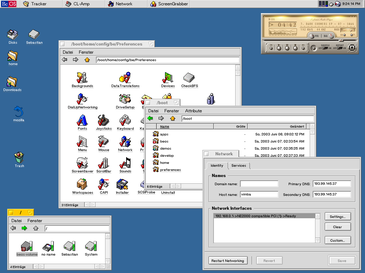


Architecture and notable features
The system emphasized parallelism and responsiveness. Key elements included a modular kernel with preemptive multitasking, pervasive multithreading at the application level, and symmetric multiprocessing (SMP) support. Its file system, the Be File System (BFS), supported indexed metadata and was optimized for fast searching and reliability. Other notable components were media and input stacks tuned for real‑time streams, a lightweight GUI toolkit, and a coherent set of developer APIs that encouraged multithreaded design.
- Preemptive multitasking and fine‑grained threads
- SMP support to use multiple CPUs efficiently
- BFS with metadata and journaling features
- Media subsystem for low‑latency audio/video processing
History and development
Be Inc. was founded by former Apple manager Jean‑Louis Gassée and began work in the early 1990s with a short run of proprietary BeBox hardware. BeOS later shifted focus to run on commodity PowerPC and x86 PCs and aimed to compete as an alternative desktop platform. The last official commercial release was known as BeOS R5. In 2001 the company and its assets were acquired by Palm, Inc., and official BeOS development ceased thereafter.
Use cases and legacy
BeOS found a niche among multimedia professionals and enthusiasts who valued its responsive audio and video handling, fast file searches, and clean API set for building media applications. After official development ended, the code and ideas inspired open‑source reimplementations and projects that sought to preserve BeOS concepts; the Haiku project is a community effort that continues to recreate and extend the BeOS experience. See more background at project and history pages and community sites at related resources.
Distinctive facts
BeOS is often cited in discussions of operating systems that prioritized multimedia and concurrency over legacy compatibility. Its combination of an indexed filesystem, pervasive threading, and SMP awareness made it technically forward‑looking for its era, and its design influenced later hobbyist and niche OS work. Although it never achieved mainstream adoption, its design continues to be studied by OS developers and enthusiasts.
Related articles
Author
AlegsaOnline.com BeOS — multimedia‑focused desktop operating system Leandro Alegsa
URL: https://en.alegsaonline.com/art/10639