
Voyager Golden Record: Earth's Message to the Cosmos
A summary of the Voyager Golden Records: their purpose, contents, design, history, and legacy as symbolic time capsules carried by the Voyager spacecraft since 1977.
The Voyager Golden Records are a pair of phonograph records attached to the Voyager 1 and Voyager 2 spacecraft, launched by NASA in 1977. Intended as a cross-cultural time capsule and a message to any intelligent extraterrestrial finders, the records were compiled to represent the diversity of life and culture on Earth. While designed with practical decoding aids, they are often described as both a sincere attempt to communicate and a symbolic gesture reflecting human curiosity.
Image gallery
10 Images


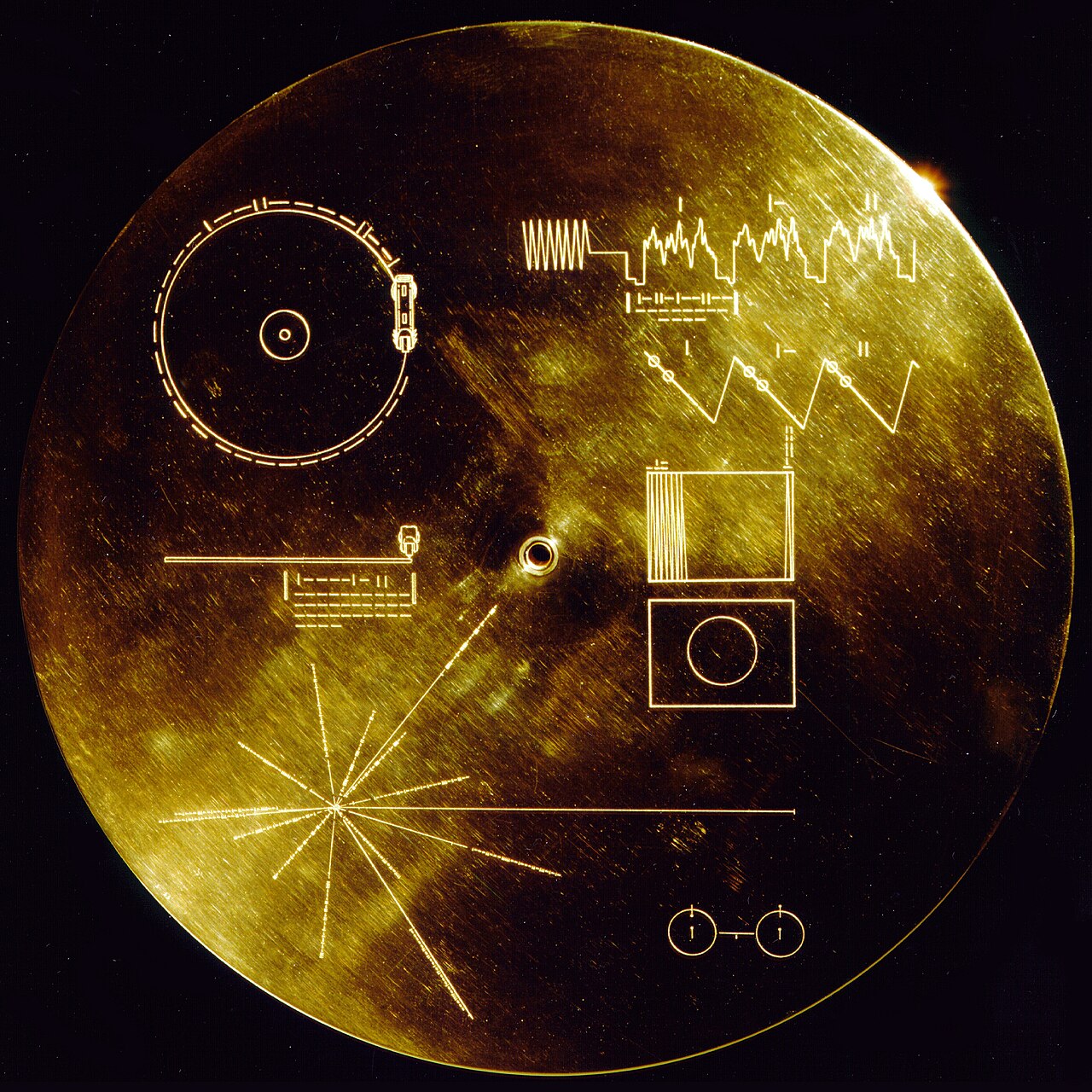

Contents and characteristics
The records combine analog audio and encoded images together with visual instructions to guide an unfamiliar recipient in playing them. Broadly known elements include:
- Greetings spoken in 55 languages and a printed message from the U.S. President at the time.
- Music from many cultures and eras — from classical compositions and world folk music to a selection of modern popular music.
- Natural sounds of Earth such as wind, thunder, animal calls and human-generated noises like footsteps or machinery.
- Photographic images depicting human life, animals, plants, landscapes, and scientific diagrams intended to explain the record’s format and the location of Earth.
Physical design features include a gold-plated master disc intended to resist corrosion and a protective cover engraved with symbolic instructions. These illustrations show how to play the record, the basic time and frequency standards used, and a map based on pulsars and universal atomic properties to help indicate the Solar System’s location.
Creation and selection
The content was chosen by a committee of scientists, artists and writers led by Carl Sagan, who sought to balance scientific clarity with cultural breadth. The selection process involved curating examples that could convey information about our biology, emotions, and social structures without relying on any single terrestrial language or convention. For details on the record’s compilation and the choices made, see the collection overview.
Design principles and instructions
Because the intended recipients are unknown, the record includes visual diagrams that aim to establish universal reference points. A diagram illustrating the fundamental transition of the hydrogen atom serves as a time and length standard; another maps nearby pulsars whose known periods can, in principle, be used to triangulate Earth’s position. The encoded images are presented as a series of lines that, when reconstructed according to the instructions, form photographs. Technical descriptions of decoding methods and the cover engraving are summarized at design and decoding notes.
History, launch and current status
The two Voyager spacecraft carrying the records were launched on trajectories that sent them past the outer planets and then out of the heliosphere into interstellar space. Voyager 1 is now the most distant human-made object from Earth; both craft continue to travel outward carrying the records as enduring artifacts of human civilization. The project and its public presentation around the 1970s — including a short recorded message by the U.S. President — have been documented and discussed in multiple retrospective accounts, for example at historical summaries.
Legacy and significance
The Golden Records occupy a unique place between science, art and diplomacy. They have inspired debate about whether active attempts to communicate with extraterrestrial intelligence are practical or ethical, and they have become iconic symbols of humanity’s desire to reach beyond Earth. Although the likelihood that any extraterrestrial intelligence will find and interpret the records is extremely small, their value endures as a cultural touchstone and a remarkable example of how humans represent themselves to the wider cosmos. Further reflections on the records’ cultural impact and ongoing relevance are available at legacy resources.
Note: The Voyager Golden Records should be understood both as technically informed artifacts designed to maximize the chance of intelligibility and as symbolic acts reflecting a particular moment in human history and optimism about communication beyond our planet.
Related articles
Author
AlegsaOnline.com Voyager Golden Record: Earth's Message to the Cosmos Leandro Alegsa
URL: https://en.alegsaonline.com/art/105968