
Video Relay Service: remote sign-language interpreting for telephone calls
Video Relay Service enables people who use sign language to communicate by phone via a live video interpreter, using broadband video, trained interpreters, and relay providers to bridge sign and voice calls.
Overview
Video Relay Service (VRS) is a telecommunications service that lets people who use sign language place and receive telephone calls through a live, remote sign-language interpreter. The caller signs to a video link, an interpreter converts the message to spoken language for the hearing person on the phone, and then signs the spoken responses back to the caller. VRS provides a near-real-time, conversational experience that is more natural for many sign-language users than text-based systems.
Image gallery
2 Images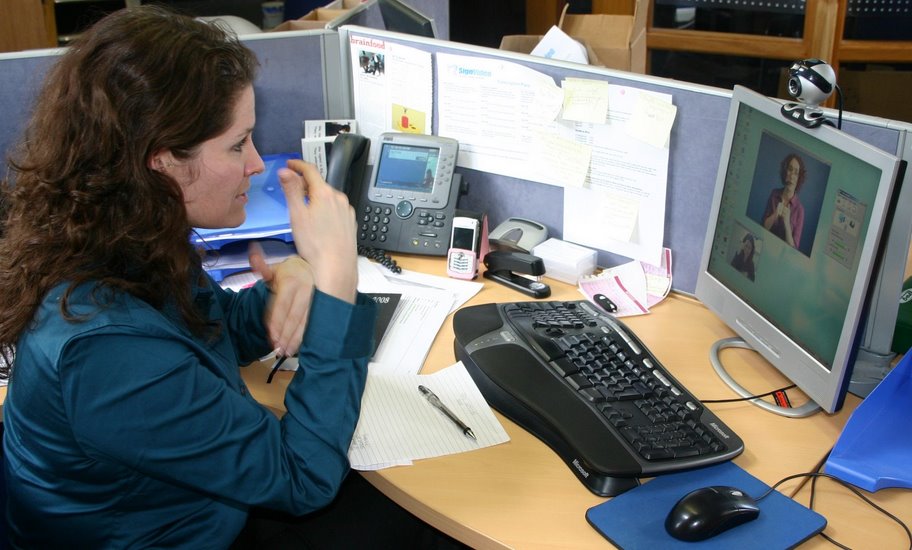

How it works
The basic components of VRS include a camera and display for the signer, a high-speed Internet connection to transmit video, and a relay service staffed by trained interpreters. A user connects to a VRS provider, often via a dedicated device, computer software, or a mobile app. When a call is placed, the VRS client connects the user to an available interpreter who appears on the screen and facilitates the conversation between the signer and the hearing party.
- User equipment: camera, display, and microphone or phone for the hearing party.
- Network: broadband or IP-based connection to carry live video with low delay.
- Interpreter: a trained professional fluent in the relevant sign language and spoken language.
- Provider platform: the software and call-routing systems that link users, interpreters, and telephone networks.
History and development
VRS originated in the 1990s with pilot systems that combined video and telecommunications to serve sign-language users. Over the following decades, improvements in video compression, widespread broadband access, and mobile devices made VRS practical and scalable. The service spread to multiple countries and in the early 21st century became widely available in places such as the United States through commercial and regulated providers.
Uses, benefits, and limitations
VRS enables fluent sign-language users to conduct personal, business, and medical calls without relying on typed messages. It supports spontaneous conversations, expressive nuance, and faster exchanges than many text systems. Common uses include calls with family, scheduling appointments, customer service, and remote interpreting for meetings.
Limitations include the need for a reliable high-speed connection, availability of interpreters for particular sign languages or dialects, and differing provisions for emergency calls or cross-jurisdictional situations. There are also privacy and security considerations because video of the caller is transmitted through a third-party service.
Regulation, access, and notable facts
In many countries VRS is overseen or supported by telecommunications authorities to ensure access for deaf and hard-of-hearing communities; funding and regulation vary by jurisdiction. Providers may be commercial or public and often must meet quality standards for interpreting. For information about sign languages in general see sign language resources. For guidance about interpreter qualification and services see interpreter information. For details on availability and policy in the United States see availability in the United States.
As technology continues to evolve, VRS platforms are adapting with improved video quality, mobile support, and integration with other communication tools, expanding options for accessible, real-time conversation across linguistic modalities.
Related articles
Author
AlegsaOnline.com Video Relay Service: remote sign-language interpreting for telephone calls Leandro Alegsa
URL: https://en.alegsaonline.com/art/105041