
Universal Mobile Telecommunications System (UMTS)
UMTS is a 3G mobile cellular system based on GSM and the IMT-2000 family. It uses W-CDMA radio access to provide higher data rates for voice, mobile internet and multimedia services.
Overview
The Universal Mobile Telecommunications System (UMTS) is a third-generation (3G) mobile network technology standardized as part of the ITU IMT-2000 family and developed by the 3GPP. Building on the GSM evolution path, UMTS introduced a wideband code-division access scheme to carry voice and packet data with substantially higher throughput and capacity than 2G systems. It enabled early mobile broadband services, video calling and richer multimedia applications.
Image gallery
3 Images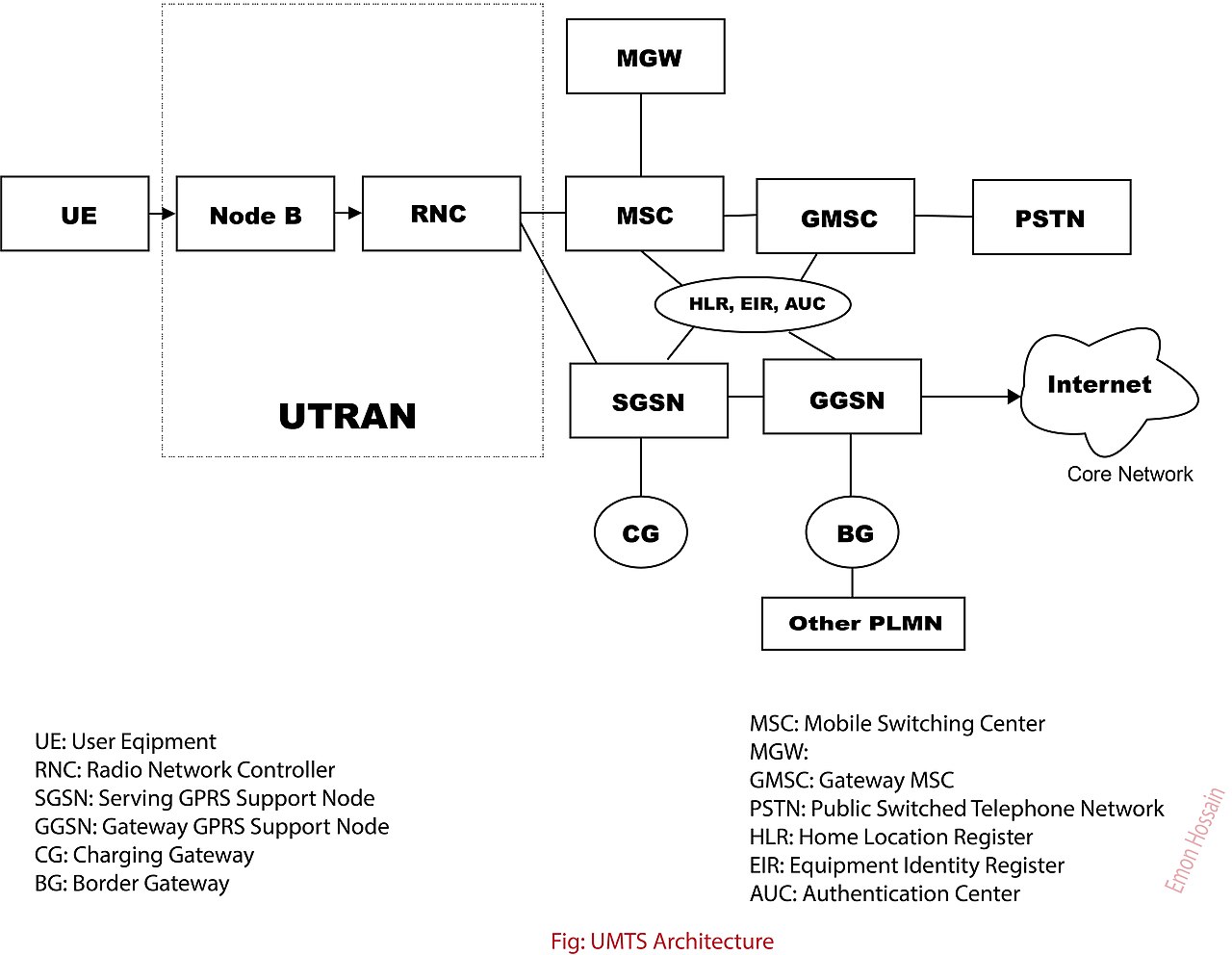

Technical characteristics
At the air interface UMTS primarily uses Wideband CDMA (W-CDMA), which allocates wider radio channels and separates users by unique spreading codes rather than by fixed time slots. Typical W-CDMA channels use a 5 MHz carrier bandwidth. The UMTS family later adopted incremental upgrades collectively known as HSPA (High Speed Packet Access), which include HSDPA and HSUPA to increase downlink and uplink speeds.
Network architecture
UMTS networks reuse and extend the core concepts from GSM while adding new radio elements. Key components include:
- Node B — the radio base station that communicates with user devices.
- Radio Network Controller (RNC) — manages radio resources and handovers within the UMTS Terrestrial Radio Access Network (UTRAN).
- Core network — retains circuit-switched elements for traditional voice and packet-switched elements (drawn from GPRS/EDGE) for data services.
History and evolution
UMTS was conceived in the late 1990s as the GSM community’s route to 3G. Commercial rollouts began in the early 2000s across many regions, with carriers introducing both voice and data services over W-CDMA. Over time, UMTS evolved through HSPA enhancements and served as the transition path to later 4G technologies such as LTE.
Uses and examples
UMTS expanded the practical use of mobile data beyond simple text and email to include web browsing, streaming audio and video, video conferencing and location-based services. Its improved data capabilities supported the first generation of smartphone applications and helped operators offer mobile broadband plans and multimedia services in the pre-LTE era.
Distinctions and legacy
UMTS is distinct from other 3G approaches such as CDMA2000: both aimed to provide comparable 3G features but followed different technical paths and ecosystem lineages. UMTS maintained compatibility with GSM signaling and roaming frameworks, which eased adoption for many carriers. Although many networks have migrated to LTE and 5G, UMTS remains important historically and is still used in places for coverage and voice fallback. For further technical and deployment details see the 3G standards overview.
Related articles
Author
AlegsaOnline.com Universal Mobile Telecommunications System (UMTS) Leandro Alegsa
URL: https://en.alegsaonline.com/art/103167