
Type 96 150 mm howitzer (Japanese Imperial Army)
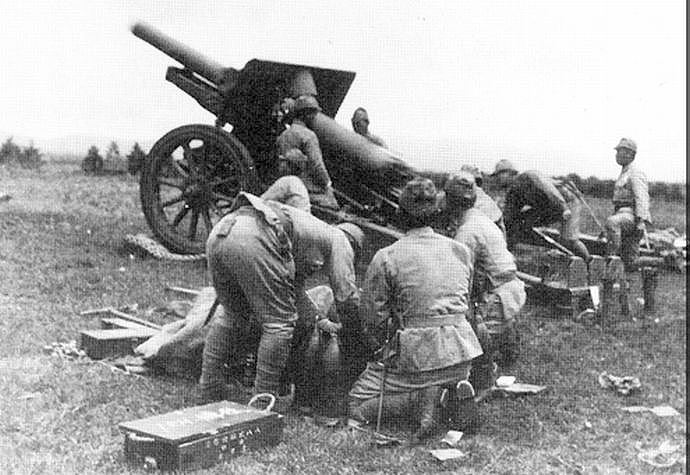
A medium-caliber World War II-era howitzer adopted by the Imperial Japanese Army in 1936, developed to replace the older Type 4 150 mm piece and used for corps- and divisional-level indirect fire.
Overview
The Type 96 150 mm howitzer (九六式十五糎榴弾砲, Kyūroku-shiki Jyūgo-senchi Ryūdanhō) was a medium-caliber field howitzer adopted by the Imperial Japanese Army. The "Type 96" designation reflects the Japanese year of adoption (2596, or 1936 in the Gregorian calendar). Intended as a more modern standard 150 mm weapon, it entered service to replace older designs and to provide heavier, high-angle indirect fire support to formations in China and later during the Pacific War.
Image gallery
4 Images


Design and characteristics
The Type 96 was a conventional howitzer in form and function: a relatively short, large-bore barrel for high-angle fire, a robust carriage suitable for towing, and fittings for indirect fire control. It fired the same 150 mm ammunition as the earlier Type 4 150 mm howitzer, which simplified logistics and resupply. Typical roles for a gun of this class included delivering high-explosive and smoke shells against enemy positions, fortifications, and troop concentrations.
Notable features
- Caliber and role: 150 mm howitzer designed for high-angle, indirect fire.
- Compatibility: used the same ammunition family as the Type 4 150 mm howitzer, easing supply and training.
- Mobility: intended to be towed behind transport—both horse and motor traction were used depending on theatre and availability.
- Deployment: fielded at corps and divisional levels to provide heavier firepower than light field guns.
Service history and use
The Type 96 saw service in the late 1930s and throughout World War II. It was employed during the Second Sino-Japanese War and in various Pacific campaigns where Japanese forces required heavier artillery support. The howitzer’s introduction reflected a wider interwar trend of modernizing artillery: replacing aging World War I-era pieces with weapons better suited to the tactical demands of the 1930s and 1940s.
Context and comparisons
As a 150 mm class howitzer, the Type 96 occupied a middle ground between lighter field guns and larger siege or coastal artillery. It succeeded the Type 4 150 mm howitzer in front-line roles and was one of several calibers in the Japanese inventory. Understanding this weapon benefits from comparing its logistics and tactical use to other contemporary systems: see references on general artillery, the Imperial Japanese Army structure, ammunition families such as the shared 150 mm rounds, details on the preceding Type 4 150 mm, and broader technical notes in sources covering Japanese artillery design.
Overall, the Type 96 150 mm howitzer represents an incremental modernization rather than a revolutionary design: it standardized caliber supply, improved tactical fire support for Japanese formations of the era, and remained in service where sufficient transportation and ammunition could be provided.
Related articles
Author
AlegsaOnline.com Type 96 150 mm howitzer (Japanese Imperial Army) Leandro Alegsa
URL: https://en.alegsaonline.com/art/102344
Sources
- books.google.com : Japanese Army in World War II: Conquest of the Pacific 1941-42, p. 50
- books.google.com : "Model 96 150-mm howitzer,"
- books.google.com : "Artillery,"