
Type 4 150 mm howitzer
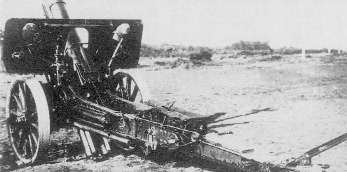
Japanese Type 4 150 mm howitzer: a heavy field howitzer adopted in 1915 for the Imperial Japanese Army, used for indirect fire, siege support, and infantry assistance through the interwar years and early World War II.
The Type 4 150 mm howitzer (Yonenshiki Jyūgosenchi Ryudanhō) was a heavy field howitzer adopted by the Imperial Japanese Army in the early 20th century. Classified as a large-calibre artillery piece, it served as a source of high‑angled, indirect fire to engage fortifications, troop concentrations and obstacles, complementing lighter field guns in Japanese formations. It is commonly referred to in English sources as a "15-cm" howitzer.
Image gallery
4 Images


Design and characteristics
The weapon was a conventional breech‑loading, tube artillery piece of its era, built to fire separate-loading ammunition (projectile plus propellant charge). As a howitzer, it featured a relatively short barrel and a carriage that permitted high elevation for plunging fire. Typical employment called for high‑explosive, smoke and illumination shells to shape the battlefield or support infantry advances. Mobility relied on towing by horses or by motor traction where available, and operation required a trained crew to manage loading, laying and fire control.
Development and service history
Adopted in the Taishō period (Type 4 corresponds to the fourth year of that era, 1915), the howitzer emerged as Japan modernized its artillery after earlier conflicts. It was produced for domestic service and equipped units through the interwar decades. The piece saw use in regional conflicts during the 1920s and 1930s and remained in inventory into the early years of the Second World War, especially in theaters where heavier, long‑range artillery was needed for siege or static operations.
Operational use and tactical role
In combat the Type 4 was deployed for indirect fire missions, counter‑battery tasks at modest ranges, and destruction of fieldworks. Its high‑angle trajectory made it suitable against entrenched positions and in mountainous terrain where direct‑fire guns were less effective. Artillery observers and sound‑ranging or optical methods were used to adjust fire; the howitzer formed part of combined arms packages alongside infantry and lighter field artillery units.
Legacy and notable facts
The Type 4 illustrates Japan's transition to more modern, diversified artillery forces in the early 20th century. Although ultimately superseded by newer designs as doctrines and technology evolved, it remained a workhorse for heavy indirect fire during its service life. It was issued to formations of the Imperial Japanese Army and represents an example of period artillery engineering and battlefield employment in East Asian conflicts of the first half of the 20th century.
- Calibre: 150 mm (often described as 15 cm in Western references).
- Role: heavy howitzer for indirect, high‑angle fire.
- Service: adopted 1915, used through interwar years and into early WWII.
Related articles
Author
AlegsaOnline.com Type 4 150 mm howitzer Leandro Alegsa
URL: https://en.alegsaonline.com/art/102333
Sources
- books.google.com : Japanese Army in World War II: Conquest of the Pacific 1941-42, p. 50
- simple.wiktionary.org : reign
- books.google.com : "Model 4 (1915) 150-mm howitzer,"
- books.google.com : D-Day in the Pacific: the Battle of Saipan, p. 35