
Beijing Capital International Airport
Major international airport serving Beijing (IATA PEK). Three terminals including the large Terminal 3, opened for the 2008 Olympics; long been a central hub for passenger and cargo traffic.
Beijing Capital International Airport is the principal international airport serving Beijing. Identified by the IATA code PEK and the ICAO code ZBAA, it occupies a key position in China’s civil aviation network and functions as a major hub for long‑haul, regional and domestic services.
Image gallery
10 Images


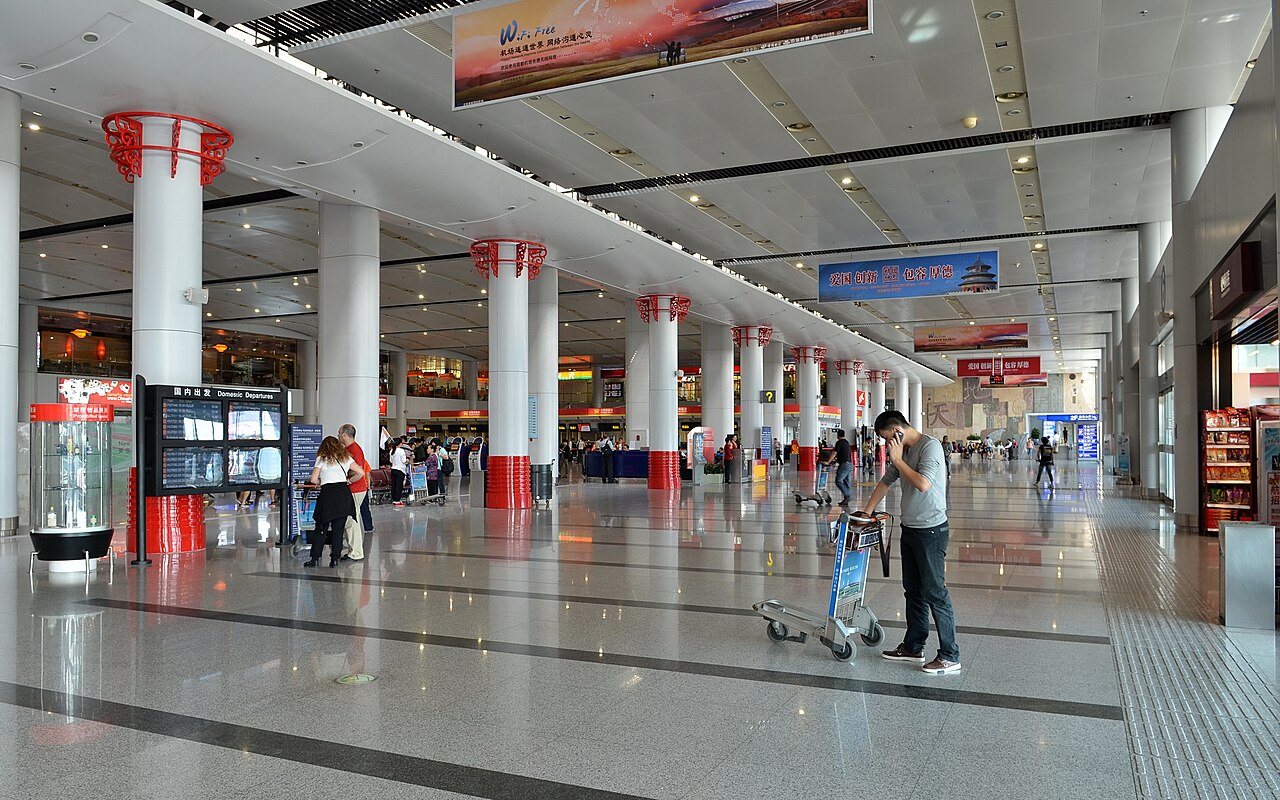


Overview and role
The airport stands in the northeastern suburbs of the city and has been the principal gateway for international visitors, business travelers and air cargo for decades. It handles passenger, freight and transit operations and is a primary hub for national carriers, providing extensive scheduled connections across Asia and to major intercontinental destinations.
Terminals and facilities
Beijing Capital has multiple passenger terminals arranged to separate domestic, regional and international flows. The most notable facility is Terminal 3, a large modern complex completed ahead of the 2008 Summer Olympics that increased capacity substantially and introduced streamlined passenger circulation and modern retail and service areas.
- Terminal 1 and Terminal 2 serve a mix of domestic and regional flights and provide standard passenger services.
- Terminal 3 was designed to handle higher volumes and to accommodate wide‑body aircraft and international carriers.
- Support facilities include cargo terminals, maintenance areas and ground transport centers.
History and development
The airport’s origins date to the mid‑20th century and it has expanded in phases to meet rapid growth in air travel. Major investment culminated in the construction of Terminal 3 for the 2008 Olympics, reflecting Beijing’s emergence as a global city and transport node. More recently, the opening of a second major airport in the region changed some route patterns, but Beijing Capital remains a central aviation facility.
Access and connections
Ground access includes expressways, coach services, taxis and a dedicated airport rail link that connects the terminals with central city stations. Short‑term and long‑term parking, passenger drop‑off and arrival halls are organized to support high volumes and to facilitate transfers between terminals and onward travel.
Significance and notable facts
For many years Beijing Capital ranked among the busiest airports worldwide in terms of passenger traffic. Its Terminal 3 is notable for its scale and contemporary design, which emphasized passenger flow, retail space and operational efficiency. The airport continues to play a vital role in connecting China with the world and supporting the capital’s business, tourism and logistics needs.
Tags
Related articles
Author
AlegsaOnline.com Beijing Capital International Airport Leandro Alegsa
URL: https://en.alegsaonline.com/art/10149
Sources
- boeing.com : Boeing.com Beijing Capital International Airport
- ecquants.com : "Beijing Capital International airport – Economic and social impact"
- aci.aero : "Preliminary world airport traffic rankings"
- caac.gov.cn : 2018年民航机场生产统计公报
- routesonline.com : "Aurora adds Vladivostok – Beijing route from Jan 2018"
- routesonline.com : Air China resumes Copenhagen service from late-May 2018
- routesonline.com : Air China adds Hanoi service from June 2018
- routesonline.com : "Air China S19 international service changes as of 28NOV18"
- routesonline.com : Air China schedules Panama City launch in April 2018
- routesonline.com : routesonline.com/news/38/airlineroute/281735/air-china-re-opens-phnom-penh-bookings-in-1q…
- businessinsider.com : "Air China will resume regular flights to Pyongyang, North Korea, citing market demand"
- routesonline.com : routesonline.com/news/38/airlineroute/270986/air-china-ns17-madrid-sao-paulo-aircraft-cha…
- macaubusiness.com : macaubusiness.com/beijing-capital-airlines-suspends-china-portugal-flights/