
Trapezoid (Trapezium) — Definition, Properties, and Uses
A trapezoid (US) or trapezium (UK) is a four‑sided polygon with at least one pair of parallel sides. This article explains terminology, properties, formulas, special cases, and common uses.

A trapezoid is a four-sided polygon distinguished by having at least one pair of parallel sides. In many sources the shape is introduced in the context of basic Euclidean plane geometry as one of several types of quadrilaterals; see quadrilateral. The parallel sides of a trapezoid are commonly called the bases, while the non-parallel sides are called the legs. The perpendicular distance between the bases is the height (or altitude).
Image gallery
10 Images


Terminology and regional differences
The name varies by region. In North America, the word trapezoid usually denotes a quadrilateral with exactly one pair of parallel sides; in British and other international usage, trapezium is the term often used for that shape. Conversely, some texts outside North America use trapezoid for the other meaning. To avoid confusion, many authors state explicitly whether they allow trapezoids to have two pairs of parallel sides (i.e., to include parallelograms) or require exactly one pair.
Basic properties
Key characteristics can be summarized as follows:
- Bases: the pair of opposite sides that are parallel.
- Legs: the non-parallel sides that connect the bases.
- Height: the perpendicular distance between the two bases.
- Midline (median): the segment joining the midpoints of the legs; its length equals the average of the base lengths.
Area and simple calculations
The area A of a trapezoid with base lengths a and b and height h is given by the familiar formula A = (a + b) × h / 2. This follows because the region can be seen as an average of two parallel edges stretched across the same height. For example, if the bases are 8 and 5 units and the height is 3 units, the area is (8 + 5) × 3 / 2 = 19.5 square units.
Special types and notable facts
Important special cases include:
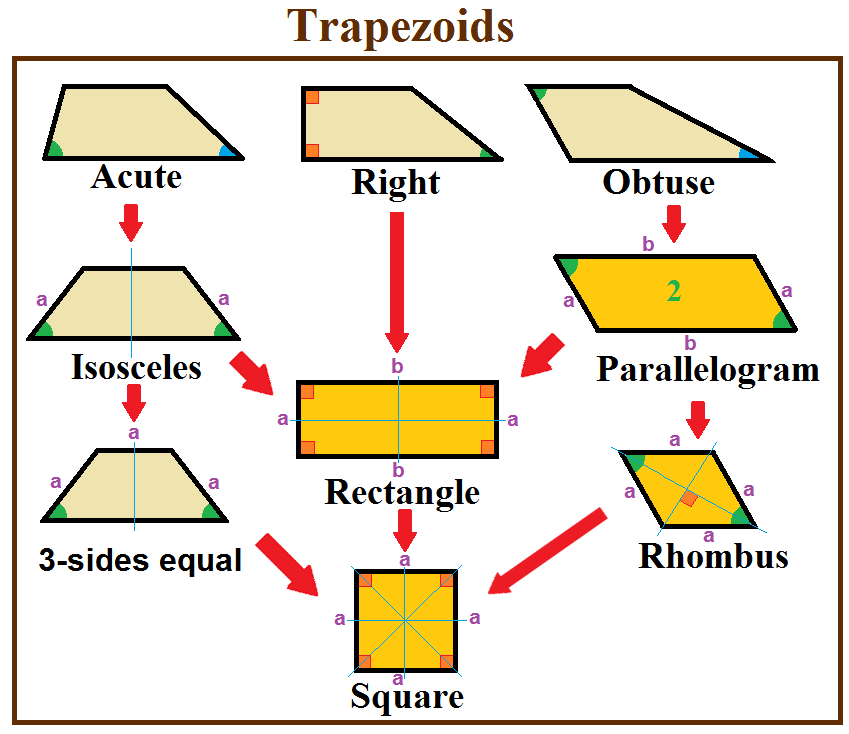
- Isosceles trapezoid: legs are equal in length; base angles are equal and diagonals are congruent.
- Right trapezoid: one or both legs are perpendicular to the bases, producing right angles.
- Parallelogram relationship: if both pairs of opposite sides are parallel, the shape is a parallelogram; whether parallelograms are considered trapezoids depends on convention.
Uses, examples, and context
Trapezoidal shapes appear in architecture, engineering, and numerical methods. Trapezoids are used in roof trusses, cross sections of beams, and in approximations such as the trapezoidal rule for numerical integration, which estimates an area under a curve by summing trapezoids. Their simple geometry makes trapezoids a common example in teaching basic properties of polygons and congruence.
Further reading
For more on quadrilaterals and related definitions consult elementary geometry texts or online resources; for an overview of parallel lines and their properties see parallel line discussions. Regional terminology conventions are often noted in school curricula and reference works to prevent ambiguity.
Related articles
Author
AlegsaOnline.com Trapezoid (Trapezium) — Definition, Properties, and Uses Leandro Alegsa
URL: https://en.alegsaonline.com/art/101219