
Tom Wolfe: Life, Work, and Influence of an American New Journalist
Overview of Tom Wolfe (1930–2018), American author and journalist known for New Journalism, major books, flamboyant style, and cultural influence in late 20th-century literature and reportage.
Overview
Thomas Kennerly "Tom" Wolfe, Jr. (March 2, 1930 – May 14, 2018) was an American author and journalist whose distinctive prose and theatrical public persona helped define a generation of literary reportage. Born in Richmond, Virginia, Wolfe rose from regional newspaper reporting in the 1950s to national prominence for books and essays that combined novelistic techniques with magazine-style investigation.
Image gallery
4 Images


Career and the New Journalism
Wolfe is widely associated with the New Journalism movement, a loose grouping of writers who in the 1960s and 1970s blurred the lines between fiction and non-fiction by using scene-by-scene construction, detailed dialogue, and close observation. He was part of the same milieu as writers such as Gay Talese, Joan Didion, and Hunter S. Thompson, and he helped popularize the idea that literary techniques could enliven serious reporting. After early work as a newspaper reporter, Wolfe became known for long magazine pieces and essay collections that addressed social trends, politics, and subcultures.
Major works and themes
Wolfe produced several books that became cultural touchstones. Notable titles include The Kandy-Kolored Tangerine-Flake Streamline Baby, which gathered his magazine essays; The Electric Kool-Aid Acid Test, an immersive chronicle of the 1960s counterculture; and The Right Stuff, an account of early U.S. test pilots and astronauts. His first novel, The Bonfire of the Vanities, was a best-seller and was later adapted into a film adaptation directed by Brian De Palma. Common themes in his work include status consciousness, American consumer culture, racial politics, and the theatricality of public life.
Style and public image
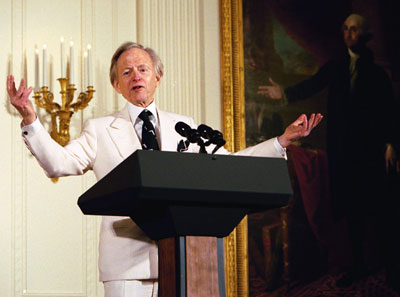
Wolfe's prose is often energetic, full of onomatopoeia, inventive metaphors, and emphatic typography. He favored long, vividly detailed scenes and a lively, sometimes satirical voice that underscored social observation. Off the page, Wolfe cultivated a recognizable image—most famously his custom white suit—which reinforced his reputation as both a literary stylist and a public commentator. Critics praised his descriptive powers and criticized him at times for perceived moralizing or theatrical excess.
Impact and reception
Wolfe's influence extended beyond individual books: he helped reshape magazine writing and inspired subsequent generations of writers to experiment with form while reporting on real events. His essays and books sparked debate about objectivity in journalism, the boundaries between reporting and storytelling, and the ethics of immersion reporting. Academics and critics continue to study his narrative techniques and cultural critiques.
Later years and death
Wolfe remained an active author and public figure into his later years, publishing novels, essays, and cultural commentary. He died in New York City on May 14, 2018 from complications related to an infection, aged 88. His papers, interviews, and the ongoing presence of his books in public discourse secure his place as a defining voice of late 20th-century American literature.
Selected bibliography
- The Kandy-Kolored Tangerine-Flake Streamline Baby (essays)
- The Electric Kool-Aid Acid Test (reportage)
- The Right Stuff (nonfiction narrative)
- The Bonfire of the Vanities (novel)
Related articles
Author
AlegsaOnline.com Tom Wolfe: Life, Work, and Influence of an American New Journalist Leandro Alegsa
URL: https://en.alegsaonline.com/art/100410