
Tōkaidō Shinkansen
Japan's first and busiest high‑speed rail line connecting Tokyo and Osaka; pioneered Shinkansen technology and remains central to intercity travel and rail innovation.
The Tōkaidō Shinkansen (東海道新幹線) is the original high‑speed rail corridor in Japan, linking the Tokyo metropolitan area with the Kansai region around Osaka. Operated by Central Japan Railway Company (JR Central), it established the core of what became the nationwide Shinkansen system. As a purpose‑built, grade‑separated high‑speed railway, the line set standards for speed, capacity and safety that have influenced rail systems worldwide.
Image gallery
7 Images


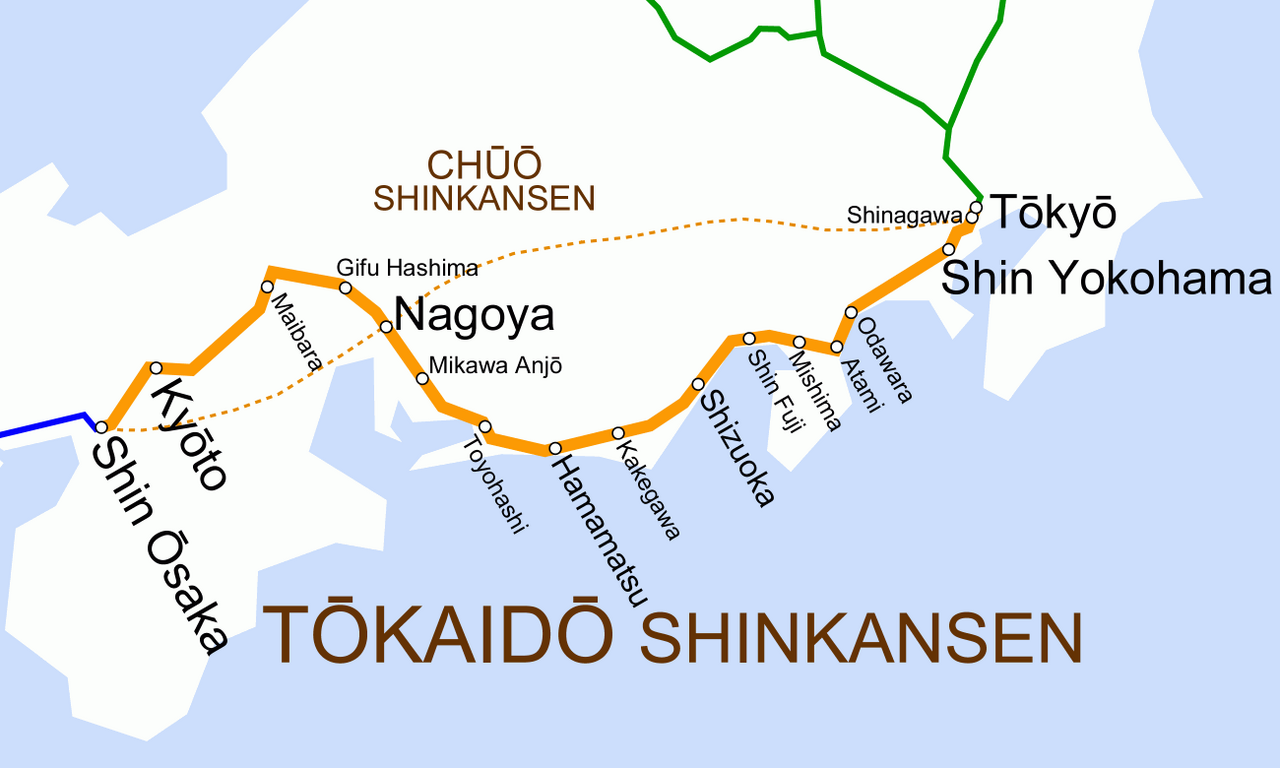

Route and services
The line runs primarily between Tokyo and Shin‑Osaka, calling at major urban centers along the Tōkaidō corridor. Regular service patterns are organized by speed and stopping pattern: fastest limited‑stop trains, intermediate expresses, and all‑stop local services. Typical named services include Nozomi, Hikari and Kodama, which differ in journey time and frequency.
- Major stations (examples): Tokyo, Shinagawa, Shin‑Yokohama, Nagoya, Kyoto, Shin‑Osaka.
- Service types: Nozomi (few stops), Hikari (moderate stops), Kodama (stops at all stations).
- High frequency: trains depart at short intervals throughout the day on peak city pairs.
History and development
Conceived in the 1950s and built in the early 1960s, the Tōkaidō Shinkansen opened in time for the 1964 Tokyo Olympic Games. Its launch introduced the first generation of dedicated high‑speed rolling stock and operational practices—continuous welded rails, gentle curves, and segregated rights‑of‑way. Over subsequent decades, successive train models and signalling upgrades increased speeds, capacity and reliability without altering the basic route.
Technology and design
The corridor is characterized by its exclusive high‑speed alignment: no level crossings, limited gradients, and track geometry optimized for sustained high speeds. Rolling stock evolved from the early 0‑series trains to later designs such as the N700 family, each improving acceleration, energy efficiency and passenger comfort. The line uses advanced signalling, strict maintenance regimes and fleet management to maintain punctuality and safety.
Impact and notable facts
Economically and socially, the Tōkaidō Shinkansen reshaped intercity travel in Japan by making day trips between Tokyo and Osaka practical and by stimulating regional development around major stations. It is often cited for its high passenger volumes and strong safety record, with very low accident and fatality rates compared with other modes of long‑distance transport. Fastest services complete the route in roughly two and a half hours, and the corridor remains one of the busiest high‑speed lines in the world.
For technical details, schedules and historical resources, see official operator pages and dedicated rail studies: Japanese name and local sources, operator information at JR Central, general high‑speed rail references via technical summaries and broader Shinkansen context at system overviews.
Related articles
Author
AlegsaOnline.com Tōkaidō Shinkansen Leandro Alegsa
URL: https://en.alegsaonline.com/art/100280