
Shinkansen — Japan's high-speed 'Bullet Train' network
The Shinkansen is Japan's network of high-speed, grade-separated passenger rail lines, introduced in 1964. It is renowned for speed, punctuality, safety and regional JR company operation.
Overview
The Shinkansen (Japanese: 新幹線) is a national network of high-speed passenger rail lines in Japan. Often called "Bullet Trains" outside Japan, Shinkansen services run on dedicated, grade-separated tracks designed for sustained high speeds and frequent service. Introduced in 1964 with the opening of the Tōkaidō Shinkansen, the system transformed intercity travel by offering rapid, reliable connections between major urban centers.
Image gallery
10 Images


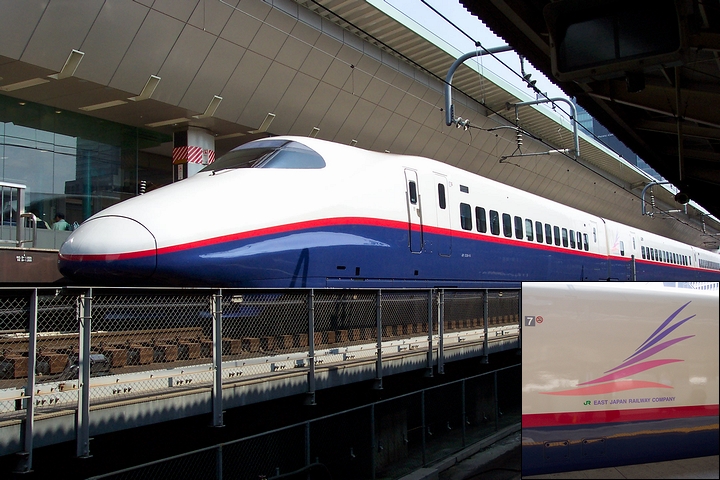


Design, rolling stock and infrastructure
Shinkansen trains operate on standard-gauge track and use electric multiple units with streamlined noses, active suspension and powerful braking systems. Key infrastructure features include continuously welded rail, extensive viaducts and tunnels, and automatic train control and signalling tailored to high-speed operation. Speeds in regular service generally range up to about 320 km/h on the fastest lines, supported by maintenance regimes and dedicated depots to ensure punctuality and safety.
Characteristics and service patterns
Services are organized by speed and stopping pattern: some trains provide nonstop or limited-stop express links between major cities, while others stop at intermediate stations to serve regional areas. Trains are scheduled with tight headways, allowing high throughput on busy corridors. Amenities typically include reserved seating, green (first-class) cars, luggage space and, on many services, catering or vending options. Unlike many freight or mixed-use lines, Shinkansen tracks are generally reserved for passenger operations only.
History and operators
The original Tōkaidō line opened to coincide with the 1964 Tokyo Olympics and marked the world's first high-speed rail service. The network expanded over subsequent decades to connect Honshū with Kyūshū and other regions. Today the system is operated by regional members of the Japan Railways Group; see the collective JR companies. These companies evolved from the former national railway and are structured as independent entities that coordinate scheduling, ticketing and maintenance across lines.
Importance, safety and international influence
Shinkansen is widely cited for its punctuality, frequency and safety record, and it has become a model for high-speed rail worldwide. Its development spurred advances in signalling, earthquake detection and aerodynamic train design. Several countries have studied or adopted technologies and operating practices derived from the Shinkansen model, while Japanese firms have been involved in international high-speed rail projects.
Network, examples and distinctions
- Major corridors include the Tōkaidō, Sanyō and Tōhoku routes, linking Tokyo, Osaka, Nagoya, Hiroshima and other cities.
- Regional JR operators manage different sections; coordination allows through services and transfers across the system — for example between services run by different companies.
- The Shinkansen system is distinct from conventional narrow-gauge Japanese lines and from urban commuter services around hubs such as Tokyo.
- After privatization, the former national operator gave way to regional entities that now function as largely private companies while maintaining public interest in safety and service standards.
For further reading on technical specifications, route maps and current operations, consult official operator resources and transport research publications via links provided by national and regional agencies (see also high-speed rail reference materials).
Japanese term • High-speed rail • Japan • JR companies • Regional companies • Private operators • Tokyo services
Questions and answers
Q: What is the Shinkansen?
A: The Shinkansen is a group of high-speed rail lines in Japan, upon which the famous "Bullet Trains" run. It is the world's first high-speed rail.
Q: Who runs the Shinkansen?
A: The Shinkansen are run by the many JR companies. In the past, Japan Railway was called Japanese National Railways and it is now one group of private companies.
Q: What other services does JR provide?
A: JR also runs commuter trains and inter-city trains around Tokyo.
Q: Where did the name 'Shinkansen' come from?
A: The name 'Shinkansen' comes from two Japanese words - 'Shin', meaning new, and 'Kansen', meaning main line or trunk line. Together they form 'Shinkansen', which literally translates to mean 'new main line'.
Q: How fast do Bullet Trains travel on the Shinkansen?
A: Bullet Trains can travel at speeds up to 320 km/h (200 mph).
Q: When was the Shinkansen introduced?
A: The first section of track opened in 1964 for service between Tokyo and Osaka, making it one of the earliest high-speed railways in operation worldwide.
Related articles
Author
AlegsaOnline.com Shinkansen — Japan's high-speed 'Bullet Train' network Leandro Alegsa
URL: https://en.alegsaonline.com/art/89831