
Tigrosa helluo — a North American wolf spider
Tigrosa helluo is a large wolf spider native to eastern North America, known for hunting without webs, carrying egg sacs and spiderlings, and a taxonomic history that moved it from Lycosa and Hogna to Tigrosa.
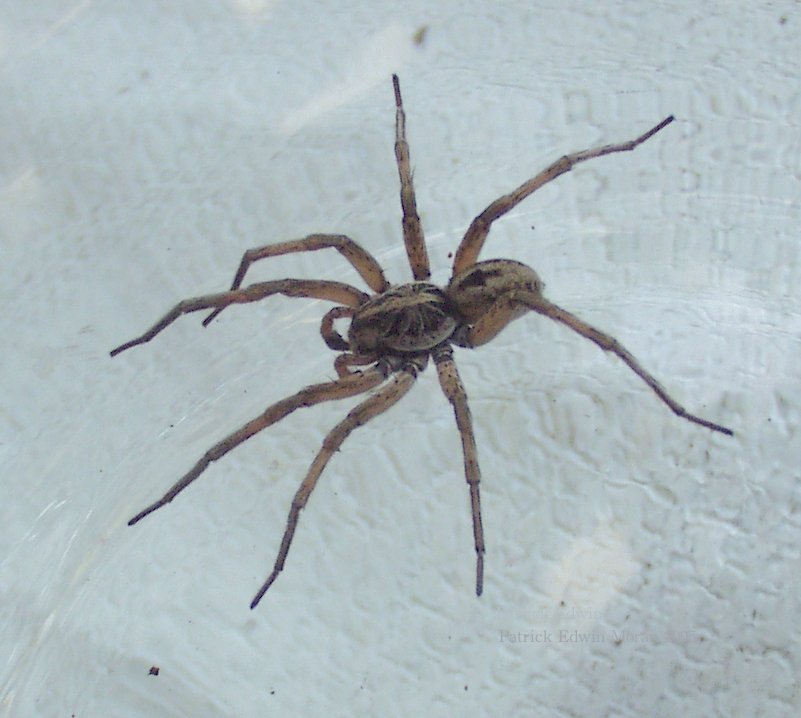
Tigrosa helluo is a species of wolf spider (family Lycosidae) native to parts of eastern North America. It is one of the larger representatives of its family and is commonly encountered in natural and semi-natural habitats where it hunts on the ground rather than building capture webs. Its behavior, life cycle and general appearance are typical of ground-dwelling wolf spiders, making it recognizable to naturalists and useful in studies of arachnid ecology.
Image gallery
4 Images


Physical characteristics
Adults show a pronounced sexual size difference: females can reach body lengths of around 20–21 mm while males are noticeably smaller, reaching roughly 12 mm. The species has a robust, low-slung body with a mottled brown coloration that helps it blend into leaf litter and soil. Like other wolf spiders, Tigrosa helluo has eight eyes arranged in three rows (a pair of large forward-facing eyes above a row of smaller eyes), which gives it good vision for detecting and pursuing prey.
Taxonomy and naming
The species has been reclassified more than once. Historically it was placed in the genera Lycosa and later Hogna, where it was known as Hogna helluo. Subsequent taxonomic revisions of the Lycosidae, informed by close study of morphological characters and modern systematic methods, transferred it to the genus Tigrosa. These changes reflect an evolving understanding of relationships among wolf spiders rather than changes in the animal itself.
Habitat and behavior
Tigrosa helluo favors ground-level habitats such as open woodlands, fields, edges, and sometimes gardens. Individuals are often found under rocks, logs or in shallow burrows; females commonly dig or use existing shallow holes and line them with silk to create retreats. Unlike orb-weaving spiders, T. helluo is a cursorial predator: it actively hunts and pounces on insects and other small arthropods, using speed and eyesight rather than a web to capture food.
Reproduction and life cycle
Females produce silk egg sacs that they attach to their spinnerets and carry as they move, a characteristic behavior of wolf spiders. Reported clutch sizes for this species range widely; in practice a female may produce on the order of a few hundred eggs per reproductive event (commonly cited ranges are around 150–500 eggs). After the eggs hatch, the tiny spiderlings climb onto the mother's abdomen and remain there for several days to a few weeks until they disperse, which provides protection during their most vulnerable stage.
Ecological role and interactions with people
As an active predator of insects, Tigrosa helluo contributes to natural pest control in its habitats. It is not considered dangerous to humans: wolf spider bites are uncommon, and when they do occur they typically cause only minor, short-lived symptoms. Because of their conspicuous size and behavior, wolf spiders such as T. helluo are frequently included in educational materials and field guides, and their natural history illustrates important concepts in predator-prey dynamics.
Related information: the family context and broader taxonomic details can be explored via the Lycosidae overview (family page), and historical classifications under the genus Hogna are discussed in older treatments (former genus Hogna).
Related articles
Author
AlegsaOnline.com Tigrosa helluo — a North American wolf spider Leandro Alegsa
URL: https://en.alegsaonline.com/art/99847
Sources
- commons.wikimedia.org : Tigrosa helluo
- catalogueoflife.org : "Species 2000 & ITIS Catalogue of Life: 2011 Annual Checklist"