
Tiktaalik: a Devonian 'fishapod' bridging fish and early tetrapods
Tiktaalik is an extinct lobe‑finned fish from the Late Devonian (~375 Ma) with a mix of fish and tetrapod features that illuminate the evolutionary transition from water to land.
Overview
Tiktaalik is a genus of extinct lobe‑finned fishes that lived in shallow freshwater environments during the Late Devonian, roughly 375 million years ago. Its fossils display a combination of features typical of fish and characteristics seen in early four‑limbed vertebrates (tetrapods). Because of this mosaic of traits, paleontologists often call Tiktaalik a "fishapod": an animal that helps document the evolutionary shift from fins to limbs.
Image gallery
10 Images
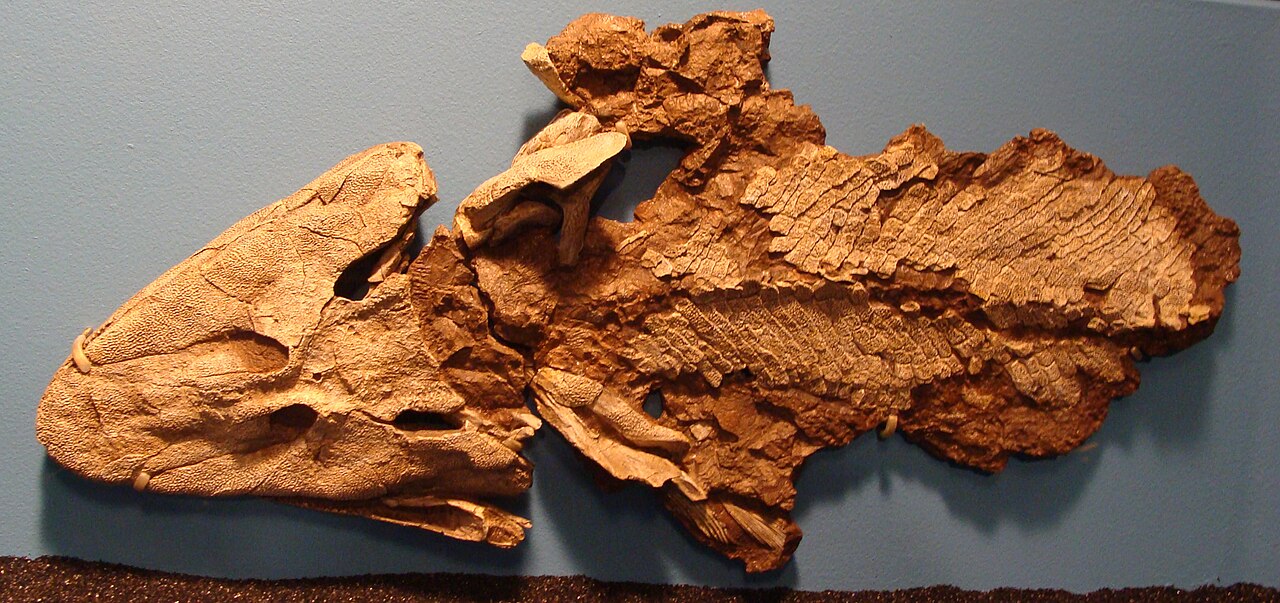


Key anatomical features
Tiktaalik combines traits found in sarcopterygians (lobe‑finned fishes) with derived adaptations more commonly associated with tetrapods. Notable characteristics include a flattened skull with eyes on top, a mobile neck permitting independent head movement, robust rib bones that might have supported the body in shallow water or on land, and paired fins containing bones that are homologous with the upper arm and forearm of tetrapods. At the same time, it retained fishlike features such as scales and fin rays.
Discovery and geological context
Fossils of Tiktaalik were first reported in the mid‑2000s from Late Devonian sediments on Ellesmere Island in the Canadian Arctic. The remains were found in deposits interpreted as river or floodplain environments, suggesting the animal inhabited shallow, vegetated waters where occasional excursions onto substrate were possible. Tiktaalik is generally dated to a little after older forms such as Panderichthys and slightly before early true tetrapods like Acanthostega and Ichthyostega, placing it squarely within the critical interval of the water‑to‑land transition.
Importance and interpretations
Scientists regard Tiktaalik as a transitional fossil because it preserves an intermediate combination of characters that illuminate how anatomical changes accumulated prior to the evolution of fully terrestrial tetrapods. Its limb‑like fins suggest that weight‑bearing elements and jointed structures evolved in aquatic settings, likely for maneuvering in shallow, debris‑filled water or propping the body up in tidal flats. The discovery strengthened the view that many features associated with terrestriality—such as strengthened ribs and a neck—originated while ancestors still relied primarily on aquatic respiration and locomotion.
Ecology, behavior and debates
Reconstructed as a predator of shallow waters, Tiktaalik probably fed on smaller fish and invertebrates. Although its anatomy indicates increased capacity for supporting its body, researchers debate how much time it spent on land versus in water. Some see it as adapted mainly to shallow, complex aquatic environments; others argue it represents an early stage of terrestrial experimentation. Regardless, it remains a key specimen for studying mosaic evolution, where different parts of the body evolve at different rates.
Related terms and further reading
For a broad introduction to Tiktaalik and its role in vertebrate evolution, look for accessible summaries and museum resources that discuss the discovery, anatomy, and the context of Devonian ecosystems. Primary scientific descriptions and subsequent studies provide more anatomical detail and debate about function and behavior.
Questions and answers
Q: What is Tiktaalik?
A: Tiktaalik is an extinct fish genus that lived about 375 million years ago.
Q: What type of fish is Tiktaalik?
A: Tiktaalik is a sarcopterygian, or lobe-finned, fish.
Q: What is significant about Tiktaalik?
A: Tiktaalik has many features similar to those of tetrapods and is part of the transition between fish and early tetrapods.
Q: When did Panderichthys live?
A: Panderichthys is known from fossils 380 million years old.
Q: When did Acanthostega and Ichthyostega live?
A: Acanthostega and Ichthyostega are known from fossils about 365 million years old.
Q: What is the term used to describe Tiktaalik's mixture of fish and tetrapod characteristics?
A: Tiktaalik's mixture of features is so unique that one of its discoverers, Neil Shubin, called it a "fishapod."
Q: What does Tiktaalik prove about the development of legs?
A: Tiktaalik and other species like it prove that legs started to develop in shallow-water carnivorous fish before these animals were land-based.
Related articles
Author
AlegsaOnline.com Tiktaalik: a Devonian 'fishapod' bridging fish and early tetrapods Leandro Alegsa
URL: https://en.alegsaonline.com/art/99857
Sources
- nature.com : "A Devonian tetrapod-like fish and the evolution of the tetrapod body plan"
- doi.org : 10.1038/nature04639
- nytimes.com : Scientists call fish fossil the missing mink
- books.google.com : Tiktaalik