
The Truman Show
1998 satirical drama film about a man unknowingly raised inside a constructed television world; directed by Peter Weir and starring Jim Carrey, exploring reality, surveillance, and media ethics.
Overview
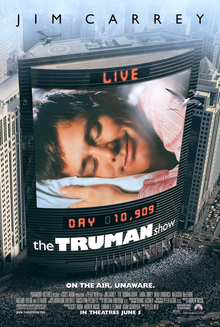
The Truman Show is a 1998 American satirical drama film directed by Peter Weir and written by Andrew Niccol. It stars Jim Carrey as Truman Burbank, a man whose entire life has been broadcast since birth without his knowledge. The picture blends comedy and drama to examine the social effects of mediated reality and the ethics of entertainment.
Image gallery
7 Images


Premise and structure
Truman grows up in Seahaven, an immaculate, enclosed town that is actually a vast television set. Every street, home and relationship has been engineered for a global audience. The show's creator monitors Truman's life from behind the scenes and manipulates events to keep the protagonist unaware and content. As small irregularities accumulate, Truman grows suspicious and begins to test the limits of his world.
Themes and cinematic approach
The film interrogates themes of surveillance, free will, authenticity, and the voyeuristic appetite of viewers. Its visual style emphasizes artificiality: bright, controlled sets, omnipresent camera viewpoints, and staged coincidences that underline the constructed nature of Truman's surroundings. The narrative raises questions about consent, exploitation and the responsibilities of media producers.
Cast, production and reception
In addition to Carrey, the cast includes notable supporting performances that anchor the story's emotional conflicts. The film marked a significant dramatic turn for its lead, who had been known primarily for broad comedic work. Upon release the movie received critical praise for its concept and performances and has been widely discussed for its prescience about reality television and digital culture.
Legacy and notable facts
- Seen as an early cultural critique of reality TV and constant surveillance.
- Frequently cited in discussions about media ethics and constructed narratives.
- Maintains a place in popular culture as a reference point for debates over authenticity.
For further reading, see contemporary reviews and essays on the film's social questions via critical analyses and archived interviews with the creative team at cast retrospectives or director commentaries at writer and production notes. Additional resources and film guides are available through curated collections at film study libraries.
Related articles
Author
AlegsaOnline.com The Truman Show Leandro Alegsa
URL: https://en.alegsaonline.com/art/99008