
The Usual Suspects
1995 neo-noir crime thriller directed by Bryan Singer, known for its twist ending, ensemble cast and the legend of the criminal mastermind Keyser Söze.
The Usual Suspects is a 1995 neo-noir crime film directed by Bryan Singer and written by Christopher McQuarrie. Blending crime drama and thriller elements, it follows the interrogation of a small-time con man and the tangled story he tells about a violent heist, a mysterious crime lord, and a string of betrayals. The film is widely discussed for its storytelling technique and surprise conclusion.
Image gallery
1 Image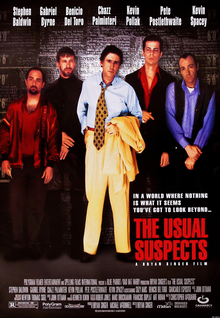
Premise and structure
The narrative unfolds largely through flashback, related by the unreliable narrator Roger "Verbal" Kint (played by Kevin Spacey), who is questioned about a massacre on a ship. Through his account viewers meet a disparate group of criminals and learn about the shadowy figure known as Keyser Söze. The movie deliberately blurs truth and fabrication, using misdirection and a slim, dialogue-driven setting to build suspense.
Key cast and characters
- Stephen Baldwin as one of the implicated criminals.
- Gabriel Byrne as Dean Keaton, a former cop turned thief.
- Benicio Del Toro as the eccentric Fenster.
- Chazz Palminteri as Kobayashi, a representative of the unseen boss.
- Pete Postlethwaite as a supporting investigator.
- Kevin Spacey as the central storyteller whose credibility is the film's pivot.
Style, themes and production
The film draws on noir conventions—moral ambiguity, shadowy antagonists and terse dialogue—while adopting a modern, economical production design. Much of its power comes from tight editing, voice-over narration, and character-driven scenes rather than spectacle. Themes include identity, mythmaking, and the unpredictability of memory when mixed with self-preservation.
Reception and legacy
Released in August 1995, the picture received strong critical attention for its screenplay and performances. It won major awards for writing and acting and helped propel its cast and creative team to broader recognition. The character of Keyser Söze and the film's twist have become reference points in popular culture and in discussions about unreliable narrators in cinema.
Notable facts
The screenplay by Christopher McQuarrie is frequently cited as an example of concise, twist-driven plotting. Viewers and critics continue to debate details of the narrative, which is a key reason the film remains a subject of analysis. For further reading and resources, see contemporary reviews and retrospective essays linked below.
Additional resources: genre overview, film analysis, actor profiles, cast interviews, production notes, awards and reception.
Related articles
Author
AlegsaOnline.com The Usual Suspects Leandro Alegsa
URL: https://en.alegsaonline.com/art/99035
Sources
- bbfc.co.uk : "The Usual Suspects (18)"
- the-numbers.com : "The Usual Suspects"