
The Unsinkable Molly Brown (1964 film)
1964 musical drama starring Debbie Reynolds, loosely based on the life of Titanic survivor Margaret “Molly” Brown; noted for its upbeat score, theatrical staging, and several Academy Award nominations.
Overview
The Unsinkable Molly Brown is a 1964 musical drama film centered on a spirited woman who rises from modest beginnings to social prominence and survives the sinking of the RMS Titanic in 1912. The title role is played by Debbie Reynolds, who brings a buoyant, determined energy to a character inspired by the historical figure Margaret "Molly" Brown. The film adapts material from earlier stage treatments and emphasizes song, dance, and populist optimism rather than strict historical accuracy.
Image gallery
1 Image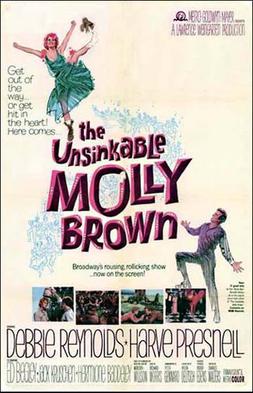
Historical basis and adaptation
The protagonist is based on Margaret Brown, commonly remembered as "Molly" Brown, an American socialite and philanthropist who became widely known after surviving the Titanic disaster. Filmmakers used her life as the starting point for a cinematic musical that dramatizes episodes of ambition, romance, and personal resilience. The story streamlines and fictionalizes many real-life details to fit the conventions of mid-20th-century musical cinema and to showcase set-piece numbers.
Production elements and style
As a musical film, the production foregrounds choreography, period costumes, and orchestral arrangements that support the central performance. Scenes alternate between rousing ensemble sequences and more intimate moments intended to reveal the heroine's character. Visual and staging choices favor theatrical clarity: large numbers, definite emotional beats, and stylized depictions of the Titanic sequence rather than documentary realism.
Reception and awards
Upon its release in the United States in June 1964, the picture received generally favorable reviews for its entertainment value, production values, and the lead actress's performance. Critics and audiences praised the film's energy while noting its loose relationship to historical fact. The film attracted several nominations at the Academy Awards, a reflection of its technical and artistic recognition within the industry.
Legacy and cultural importance
The Unsinkable Molly Brown occupies a distinctive place among 1960s Hollywood musicals: it married a biographical subject with the conventions of Broadway-style showmanship, helping to keep large-scale musicals in the public eye during a transitional era. The character of Molly Brown—portrayed here as irrepressibly optimistic and socially active—has continued to serve as a popular reference point in discussions of early 20th-century American women who combined public philanthropy with an independent spirit.
Notable facts and distinctions
- The film prioritizes theatrical storytelling over strict historical detail, using the Titanic episode as a dramatic climax rather than a documentary reconstruction.
- Its title echoes the popular nickname "Unsinkable Molly Brown," which originated after the Titanic and became associated with public tales of courage and perseverance.
- While based on a real person, the movie is best understood as a character-driven musical biography rather than a definitive life history of Margaret Brown.
- For further reading on the actress and the historical figure, see biographies of Debbie Reynolds and studies of Titanic survivors, which explore how life stories are adapted for stage and screen; other resources can be located through film and historical archives.
Because the film balances entertainment and historical reference, it remains of interest both to fans of classic Hollywood musicals and to those curious about how cinema reshapes real lives for dramatic purposes. The portrayal continues to invite discussion about representation, popular memory, and the ways musicals can interpret historical events.
Additional context and materials about the film, the performer, and the real Margaret Brown are available through film studies collections and biographical resources that trace adaptations from stage musicals to motion pictures. For primary credits, reviews, and archival materials consult specialized databases and library holdings.
More on Molly BrownRelated articles
Author
AlegsaOnline.com The Unsinkable Molly Brown (1964 film) Leandro Alegsa
URL: https://en.alegsaonline.com/art/99031