
The Theory of Everything (2014 film)
Biographical romantic drama about Stephen and Jane Hawking: production, cast, source memoir, score, critical reception and the film’s portrayal of disability and scientific life.
Overview
The Theory of Everything is a 2014 British biographical romantic drama directed by James Marsh. It dramatizes the relationship between the physicist Stephen Hawking and his first wife, Jane, tracing Hawking’s early scientific achievements, diagnosis with motor neuron disease, and the couple’s personal life as his condition progresses. The screenplay, adapted from Jane Hawking’s account, focuses on love, ambition and the changing roles within a family facing a degenerative illness.
Image gallery
4 Images
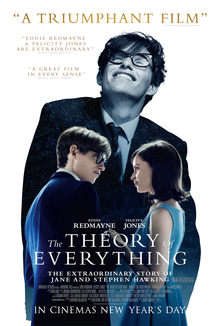


Source material and development
The film is principally based on Jane Hawking’s memoir Travelling to Infinity: My Life with Stephen, which provided the intimate point of view for the story. The screenplay was written to translate that autobiographical voice into a cinematic narrative that balances private moments with public milestones in Hawking’s career. Composer Jóhann Jóhannsson supplied the score, which underscores the emotional arc and the changes in tempo between scientific discovery and domestic struggle.
Cast and key contributors
The film’s principal performers include:
- Eddie Redmayne as Stephen Hawking, a role that received widespread acclaim.
- Felicity Jones as Jane Hawking, portraying the demands of caregiving and her own growth.
- Emily Watson, David Thewlis, and Felicity Jones among other supporting performers who populate the scientific and family circles.
- Other credited cast members include Charlie Cox, Simon McBurney, Christian McKay and Harry Lloyd, who contribute to the period setting and interpersonal dynamics.
Release and reception
The film premiered at the Toronto International Film Festival on 7 September 2014 (TIFF) and opened broadly in the United Kingdom on 1 January 2015 (UK release). Critics generally praised the performances, particularly Redmayne’s embodied depiction of Hawking’s physical decline and Felicity Jones’s work as Jane. Reviews highlighted the film’s focus on emotion and relationship over exhaustive scientific explanation, and it attracted attention during awards season.
Awards, impact and notable aspects
The production received multiple award nominations and wins at major ceremonies, including Academy Award recognition; its success helped introduce Hawking’s personal story to a wide global audience. Critics and scholars noted the film’s strengths in acting and score while also discussing its selective viewpoint: because it is adapted from Jane Hawking’s memoir, the narrative reflects her perspective and choices about what to emphasize or compress.
Accuracy and themes
While grounded in real events, the film is a dramatization that condenses years of life into a cinematic timeframe. Themes include the tension between intellectual ambition and family responsibility, the lived experience of disability, and the public fascination with a scientist who became a cultural figure. Viewers and commentators have used the film as a prompt to explore Hawking’s scientific contributions, Jane’s recollections, and broader questions about representation and caregiving in biographical cinema.
Related articles
Author
AlegsaOnline.com The Theory of Everything (2014 film) Leandro Alegsa
URL: https://en.alegsaonline.com/art/98976
Sources
- variety.com : "Stephen Hawking biopic 'Theory of Everything' set for Nov. 7 launch"
- huffingtonpost.com : "'The Theory of Everything' trailer is a heartbreaking inspiration"