
The Miserable Mill (A Series of Unfortunate Events, Book 4)
Fourth book in Lemony Snicket’s A Series of Unfortunate Events. The Baudelaire orphans confront fresh dangers at a lumber mill while the narrator's darkly comic voice defines the series' tone.
Overview
The Miserable Mill is the fourth book in the children's gothic series A Series of Unfortunate Events, written under the pen name Lemony Snicket (the authorial identity of Daniel Handler). First published as part of a continuing sequence about the Baudelaire orphans, this volume follows the siblings as they are placed in the care of a new guardian and encounter fresh misfortune and menace. Like other books in the series, it mixes bleak humor, wordplay, and moral ambiguity aimed at older children and adults.
Image gallery
2 Images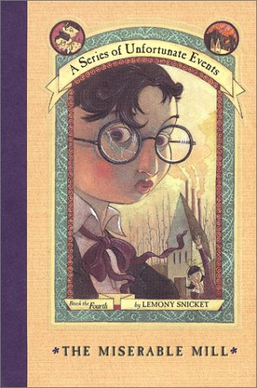

Plot elements and characters
Without revealing spoilers beyond the premise, the story centers on Violet, Klaus, and Sunny Baudelaire as they adapt to life working and living around an industrial setting. A familiar antagonist returns in disguise with a scheme to regain control of the orphans' fortune. The book emphasizes the children’s resourcefulness and their struggle against deceitful adults who both fail to protect them and sometimes actively endanger them.
Notable recurring figures and motifs include the enigmatic narrator, the relentlessly unlucky protagonists, and the villainous Count Olaf. The narrative frequently interrupts itself with definitions, ironic commentary, and warnings to the reader, which are hallmarks of the series' voice.
Themes, style and reception
The Miserable Mill explores themes of authority and incompetence, the unreliability of adults, and the moral complexity of survival. Stylistically it uses dry, macabre humor, formal asides, and playful vocabulary lessons. Critics and readers often praise the series for its wit and its willingness to treat difficult emotions honestly, though its dark tone and repeated misfortune are sometimes noted as challenging for younger readers.
Features that distinguish the book include:
- A narrator who addresses the reader directly and supplies footnote-like digressions.
- Language play and deliberately precise definitions of obscure words.
- A setting that contrasts industrial gloom with the children’s inventive problem-solving.
As part of a long-running series, The Miserable Mill contributed to the continuing arc that drove adaptations in other media, including film and television interpretations that have drawn on episodes from multiple volumes. Readers encountering this installment will find an episode that both stands alone and advances the larger narrative about the Baudelaire siblings' struggle against persistent misfortune.
Related articles
Author
AlegsaOnline.com The Miserable Mill (A Series of Unfortunate Events, Book 4) Leandro Alegsa
URL: https://en.alegsaonline.com/art/98475