
The Marrying Kind (1952 film)
A 1952 American comedy‑drama directed by George Cukor that examines a long marriage through conversational flashbacks; notable for Judy Holliday's lead, supporting turns by Ruth Gordon and Aldo Ray, and an early Charles Bronson.
Overview
The Marrying Kind is a 1952 American comedy‑drama directed by George Cukor. The film offers a close, largely verbal portrait of an ordinary married couple who revisit their history when separation appears possible. Rather than relying on spectacle, it uses small domestic incidents and memory to explore why people remain together despite recurring tensions.
Image gallery
1 Image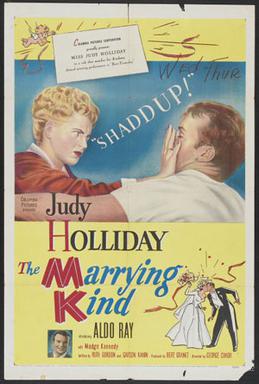
Plot and themes
The narrative proceeds through extended conversations and recalled scenes that alternate between comic detail and poignant moments. The drama concentrates on everyday pressures—work, childrearing, money, in‑laws—and how misunderstandings and personal pride can erode intimacy. Major themes include communication, compromise, the changing social expectations of post‑war America, and the quiet endurance of ordinary relationships.
Cast and performances
Judy Holliday leads the film with a performance that balances comic timing and human sympathy; her approach keeps the characters believable rather than cartoonish. Aldo Ray plays the husband's role with a rougher, more world‑weary persona, while veteran character actress Ruth Gordon provides supporting color. An early screen appearance by Charles Bronson is of interest to later fans; he appears in a small but noticeable supporting part. The ensemble work is frequently cited as the film's chief strength.
Production and release
Directed by Cukor, known for his attention to actors and performances, the film was produced within the studio system and released by Columbia Pictures. Its intimate scale and emphasis on dialogue place it among other mid‑century domestic dramas that foreground character over plot. Contemporary reviewers noted the film's restrained tone and its focus on realistic, adult concerns.
Reception and legacy
At release the film drew praise for acting and tone rather than for novelty. Over time it has been regarded by some film historians as a representative example of post‑war studio dramas that treated marriage with both affection and a candid eye. The performances, especially by Holliday and Gordon, are often singled out in retrospective accounts.
Why it matters
The Marrying Kind remains of interest for students of classic cinema because it combines a director's attention to performers with a subject—marriage—treated in a way that feels both specific to its era and broadly human. Its compact, dialogue‑driven structure makes it useful as a study of character interaction and social expectations in early 1950s American film.
- Director: George Cukor
- Star: Judy Holliday
- Supporting: Ruth Gordon, Aldo Ray
- Early appearance: Charles Bronson
- Distributor: Columbia Pictures
Related articles
Author
AlegsaOnline.com The Marrying Kind (1952 film) Leandro Alegsa
URL: https://en.alegsaonline.com/art/98423