
The Mephisto Waltz (1971 film)
A 1971 American supernatural horror film directed by Paul Wendkos, adapted from Fred Mustard Stewart's novel. It mixes occult themes, classical music, and a Faustian bargain set among elite musicians.
Overview
The Mephisto Waltz is a 1971 American supernatural horror film directed by Paul Wendkos and adapted from the novel by Fred Mustard Stewart. The story centers on the collision of the classical-music world with occult practice: a talented but troubled pianist, a critic drawn into a dangerous obsession, and a dark bargain that threatens identity and soul. The film was released by 20th Century Fox and features prominent performances from its principal cast.
Image gallery
1 Image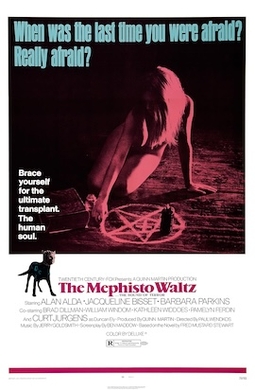
Plot and themes
The narrative weaves elements of psychological thriller and supernatural horror. Central to the plot are themes commonly associated with the Faust legend: the pursuit of artistic greatness at any cost, youthful vitality exchanged for moral compromise, and the idea of possession or transfer of consciousness. The film's title alludes to the "Mephisto Waltz," a phrase most famously associated with Franz Liszt's piano pieces inspired by the Mephistopheles figure from Goethe's Faust, and the score and scenes make sustained use of classical piano as both atmosphere and plot device.
Production and historical context
Produced in the early 1970s, the film arrived during a period when Hollywood frequently explored occult and supernatural subjects, blending psychological realism with more explicit horror elements. Director Paul Wendkos guided a cast that brought mainstream star power into the genre, adapting Stewart's novel into a compact, moody film focused on character interactions as much as shock. The cinematic approach emphasizes mood, music, and a creeping sense of wrongness rather than graphic spectacle.
Reception and legacy
On release the film received mixed reviews: some critics praised its performances and eerie atmosphere, while others found the story uneven. Over time it has retained attention among fans of occult and musical horror for its unusual premise and the contrast between elegant settings and sinister undercurrents. It is often cited as an example of how classical music and horror can be combined to explore questions of identity, talent, and the cost of ambition.
Cast, notable facts and further reading
- Alan Alda — plays a central role as the critic drawn into the mystery.
- Jacqueline Bisset — co-stars as a character caught between the musical world and the occult influence.
- Bradford Dillman — appears among the supporting cast in a key part.
- Paul Wendkos — director; his work shapes the film's atmospheric pacing.
- Fred Mustard Stewart — author of the original novel adapted for the screen.
Because of its focus on musicians, bargains with dark forces, and questions about where talent and selfhood meet, The Mephisto Waltz remains a distinctive entry in early 1970s American horror. For those researching film adaptations of Faustian literature or the role of classical music in cinema, it offers a striking example of crossover between high-culture motifs and genre storytelling.
Questions and answers
Q: When was The Mephisto Waltz released?
A: The Mephisto Waltz was released in 1971.
Q: Who directed The Mephisto Waltz?
A: The Mephisto Waltz was directed by Paul Wendkos.
Q: What is The Mephisto Waltz based on?
A: The Mephisto Waltz is based on a novel of the same name by Fred Mustard Stewart.
Q: Who are some of the stars of The Mephisto Waltz?
A: The stars of The Mephisto Waltz include Alan Alda, Jacqueline Bisset, Barbara Perkins, Bradford Dillman and Curd Jürgens.
Q: Which company distributed The Mephisto Waltz?
A: The Mephisto Waltz was distributed by 20th Century Fox.
Q: What genre is The Mephisto Waltz?
A: The Mephisto Waltz is a horror movie.
Q: Is The Mephisto Waltz an American movie?
A: Yes, The Mephisto Waltz is an American movie.
Related articles
Author
AlegsaOnline.com The Mephisto Waltz (1971 film) Leandro Alegsa
URL: https://en.alegsaonline.com/art/98450