
The Last Emperor (1987 film)
1987 historical drama by Bernardo Bertolucci about Puyi, the final Qing emperor. Noted for permission to film inside the Forbidden City and for winning multiple Academy Awards, including Best Picture.
The Last Emperor is a 1987 historical drama film directed by Bernardo Bertolucci that dramatizes the life of Puyi, the last emperor of China. The narrative follows Puyi from his installation as a child ruler through exile and reinvention during a tumultuous period of Chinese history. The film blends biographical detail with cinematic interpretation to examine power, identity and the decline of imperial rule.
Image gallery
2 Images
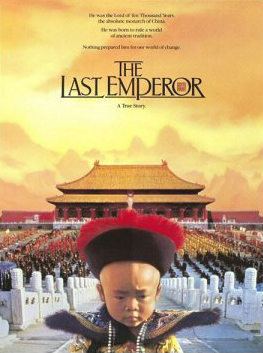
Subject and structure
The story is adapted from historical accounts of Puyi's life and presents key episodes: his upbringing within the Forbidden City, the influence of court eunuchs and regents, foreign intervention, and later roles under Japanese occupation and the People's Republic. The screenplay compresses decades into a sweeping, character-focused arc rather than a strictly documentary chronology.
Production and filming
Notable for its production scope, the film was an international co‑production that gained uncommon access to shoot inside the Forbidden City, a first for a Western feature. Cinematography, production design and location work emphasize scale and atmosphere, creating visual contrast between ritualized court life and the modernizing world beyond the palace walls.
Cast and creative team
- Directed by Bernardo Bertolucci; cinematography and visual style were central to its impact.
- Principal performances depict Puyi across stages of life, supported by a multinational cast that evokes the film's historical setting.
- Production involved international crews and designers to recreate early 20th‑century China.
Awards and significance
The film received major international recognition, winning multiple Academy Awards, including Best Picture and Best Director, and garnered numerous other honors. Its success brought renewed global attention to cinematic treatments of modern Chinese history and demonstrated the possibilities of large-scale international filmmaking in China.
For further information, production notes and contemporary reviews see the film entry at The Last Emperor.
Related articles
Author
AlegsaOnline.com The Last Emperor (1987 film) Leandro Alegsa
URL: https://en.alegsaonline.com/art/98302
Sources
- nytimes.com : "Is 'The Last Emperor' Truth or Propaganda?"
- nytimes.com : "'Last Emperor' Wins 4 Golden Globe Awards,"
- oscars.org : "The 60th Academy Awards (1988) Nominees and Winners"
- nytimes.com : "The Oscar Winners,"