
The Hours (2002 film)
A 2002 drama film adapted from Michael Cunningham's novel, directed by Stephen Daldry. It interweaves three women's lives across different eras and won Nicole Kidman an Academy Award.
The Hours is a 2002 dramatic film directed by Stephen Daldry and adapted by David Hare from Michael Cunningham's novel. The narrative links three women's stories across time: a novelist struggling with illness, a 1950s housewife in emotional crisis, and a contemporary woman trying to keep her life together. The film was produced as an Anglo-American collaboration and attracted wide attention for its performances and formal ambition.
Image gallery
1 Image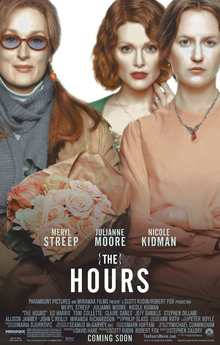
Structure and principal cast
The movie uses parallel editing to draw thematic connections among its protagonists rather than a single linear plot. Key performances include Nicole Kidman, Julianne Moore and Meryl Streep. Other supporting actors fill roles that reinforce the central concerns of loss, identity and creative work.
- Nicole Kidman as the novelist figure.
- Julianne Moore as a struggling 1950s mother.
- Meryl Streep as a modern woman confronting choices.
Production and style
Adapted from the 1998 novel, the screenplay preserves the book's focus on interior life and literary echo — notably the influence of Virginia Woolf's Mrs Dalloway. The production is noted for its period detail, careful cinematography and a spare score that underscores mood and repetition. As an Anglo-American collaboration, it combined British and American talent and resources.
Themes and critical response
The film explores depression, the constraints of social expectation, and how art and daily life intersect. Critics generally praised its acting and adaptation choices, highlighting the subtle ways the three timelines illuminate one another. The movie received widespread awards attention and multiple Academy Award nominations.
Its awards recognition included nine Academy Award nominations and a win for Best Actress for Nicole Kidman. For readers seeking further background on the novel, the adaptation process, or curated analyses, consult resources linked to the cast and the original book, or coverage of the film's reception and influence in contemporary cinema (film entry).
For cast biographies and interviews see individual profiles such as Julianne Moore and Meryl Streep, and for production history consult archives and retrospectives that document the film's development and cultural impact.
Related articles
Author
AlegsaOnline.com The Hours (2002 film) Leandro Alegsa
URL: https://en.alegsaonline.com/art/98169